


BB: Many of your exhibitions seem to function as part of a broader intellectual conversation rather than simply presenting individual artists. What does this conceptual framework allow?
MB: Yes, I would say that especially with group exhibitions, I like to bring together artists, often across different disciplines, whose works speak to broader societal conversations or intellectual discourses. In exhibition making, I find it interesting that by bringing together works of artists that are thinking about similar concepts, you get this dialectical creation of meanings. They say something on their own, and maybe something else when together with other works, and in that way, you can create endless possible readings. If artists think about specific concepts in their work, combining their work with others reinforces said ideas in new ways. But also sometimes it’s interesting to have artists whose practices explore themes that are perhaps more adjacent than exactly overlap. Unexpectedly, they might bring out new aspects of each other's practice, bring out new meanings. And then for a viewer, there are different entry points to start to get into the themes the exhibition touches upon. But it’s always open-ended, never trying to illustrate a firm curatorial thesis.
In solo exhibitions, however, I try to not impose that much of a conceptual framework, but present it as a body of work that still speaks to each other and to the artist's broader practice. It’s more like a survey into the artist's practice at that moment in time. The works are more presented on their own terms. For each solo exhibition, I publish a book, and usually I bring in a writer, curator, or other gallerist who writes an essay or conducts an interview. So in a different way, you embed the exhibition in a wider conversation by bringing in perspectives of others.

BB: Across Night Café’s programme, successful art seems presented as something that generates conversation rather than providing answers. Has creating these conversations become one of the outcomes you’re curating?
MB: I hope so! I’m interested in exhibition making that remains open. The artist proposes something through the work, and the exhibition is the place where those works together are encountered. Altogether, it becomes a sort of array of unfixed propositions. What viewers take away from that encounter will inevitably differ according to their own experiences and perspectives. So meaning isn’t fixed in advance but appears through wh

at each viewer brings to it.
As I mentioned before, it’s not the intention to present an authoritative curatorial thesis, but it’s more about raising these questions, hopefully generating conversations and giving the space for everyone to come up with their own takes. For anyone who had to read Barthes in uni, this all probably sounds like the arguments from ‘Death of the Author’, and I can’t say that this viewpoint doesn’t have its foundation in there. But I think this ability to raise these questions that don’t have definitive answers is one of art’s greatest strengths.
BB: If dialogue is something the gallery is working towards curating, how can you recognise its success? Is it something you can observe or is it more intangible?
MB: I think it’s largely intangible. There are signs, though. You might notice someone spending a long time at an exhibition, asking very precise questions, buying the exhibition book, returning to see it, or discussing it long after it has ended. Then it probably means that it’s sparking something. But these discussions might very well happen without me or the artists knowing it.

BB: One thing that stood out to me in Better than Expected, Worse than I Hoped was its emphasis on slowness. Is encouraging sustained looking an important part of Night Café’s curatorial philosophy?
MB: Absolutely. Images flash by every second of every day. We’re thoughtlessly entertained, trying to be sold stuff, politically persuaded by them. Images are rarely neutral, most of them have some form of an effect, consciously or unconsciously. But when are we really carefully looking? The best artworks make me feel like it’s a puzzle I want to solve. It’s like I want to figure out why it’s doing what it’s doing. If it’s a painting, what are the elements of the composition that make it sing? If it’s a sculpture, in what ways are the materials structured that draw me in? The complexity within a single artwork doesn’t always reveal itself straight away, and neither does the relationship between the works. Depending on the work, you might need some context to understand the take of the artist. But for me the interesting works aren’t didactic, but leave room for people to bring in their own interpretations. You can have an immediate reaction, your brain is picking up on something that you need to spend time with your thoughts to understand why it’s doing what it’s doing. I think this is what first happens with every artwork itself, and then with an exhibition as a whole. As I mentioned before, like the works themselves, the exhibitions don’t try to communicate one singular message, so this slow, sustained looking is essential.

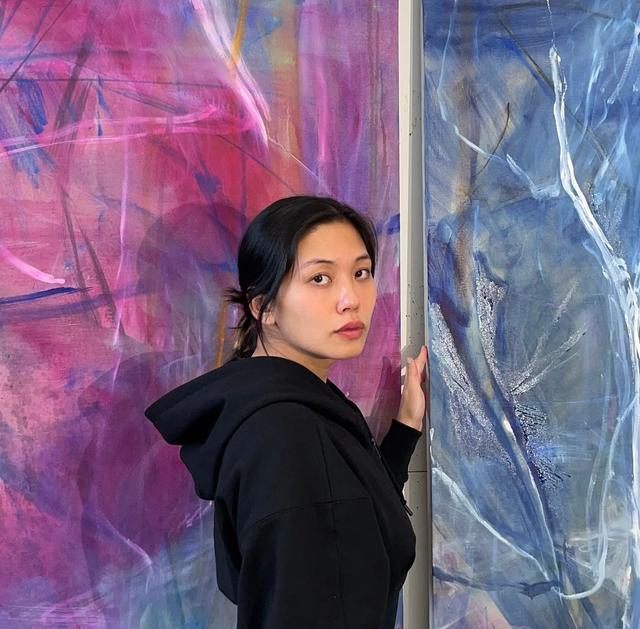
BB: In Portals of Transcendence, Helen Frankenthaler is presented in an active dialogue with contemporary painters Freya Fang Wang, Anna Pakosz and Meryl Yana rather than as a historical reference. What conversations arise from curating that kind of intergenerational dialogue?
MB: If you look at art history, it took centuries to get to abstraction. It took artists gradually loosening the grip of representation until painting no longer had to depict the visible world. And then, colour and composition could exist in their own right. That opened up endless possibilities for painting, and I think artists are still exploring those pictorial possibilities today.
Helen Frankenthaler did something incredibly important within abstraction. In the way she handled paint, she was able to create these environments that almost transport you somewhere else. I don’t use the word transcendence lightly. Standing in front of her work, you get this feeling that you’re experiencing something bigger than the physical canvas itself. That’s something quite extraordinary to achieve.
This exhibition was beautifully guest curated by Claudia Cheng, and I think she found three wonderful contemporary painters who, whether through technique or composition, are still pursuing painting’s ability to create that kind of experience. I think that’s one of the exciting things about bringing artists from different generations together. It shows that there are certain artistic pursuits that don’t really disappear. Artists keep returning to them, finding completely new ways of approaching them. Rather than presenting Frankenthaler as a historical figure, the exhibition shows that these pursuits are still very much alive.

Comments
Leave a comment