

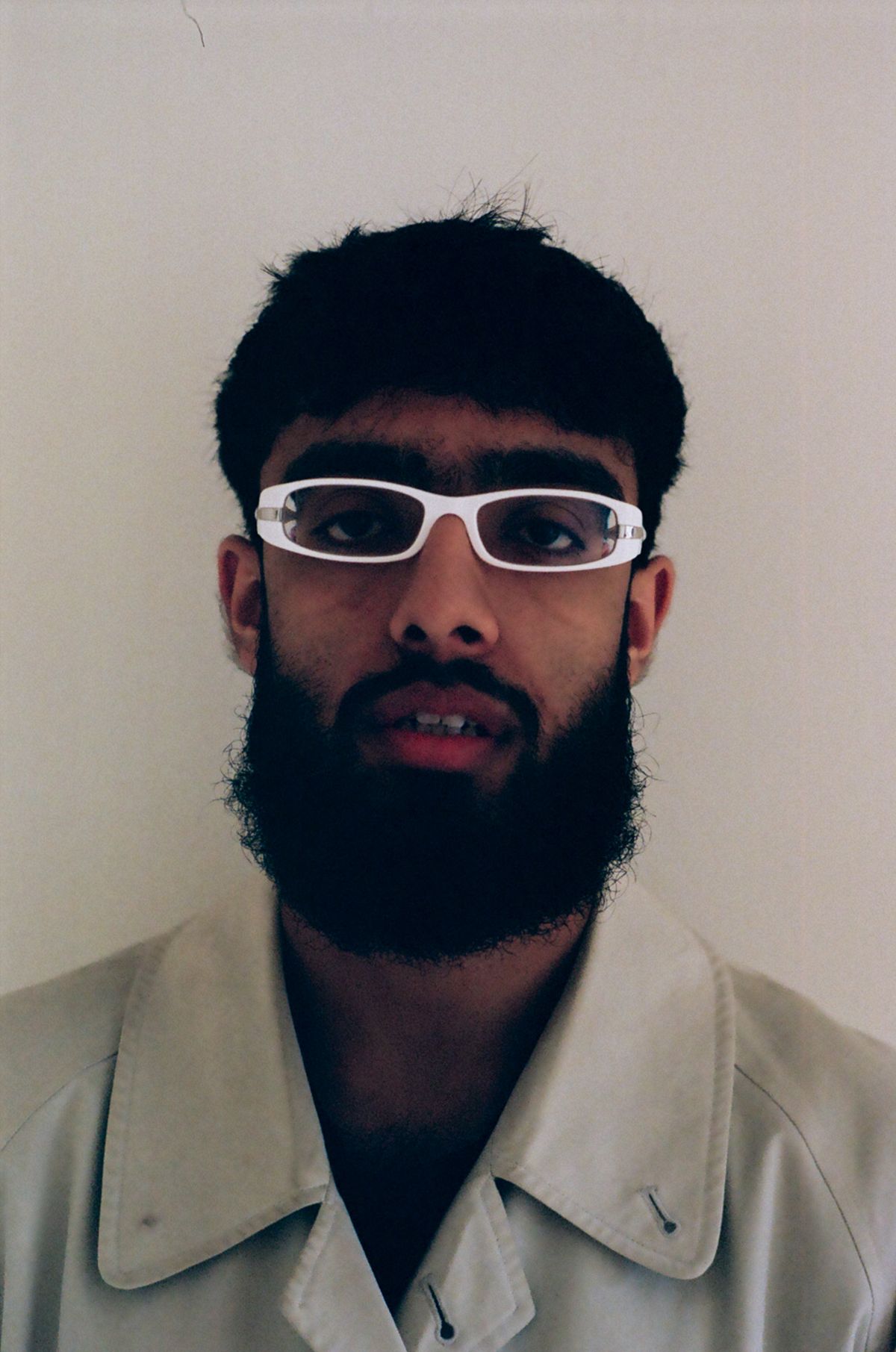
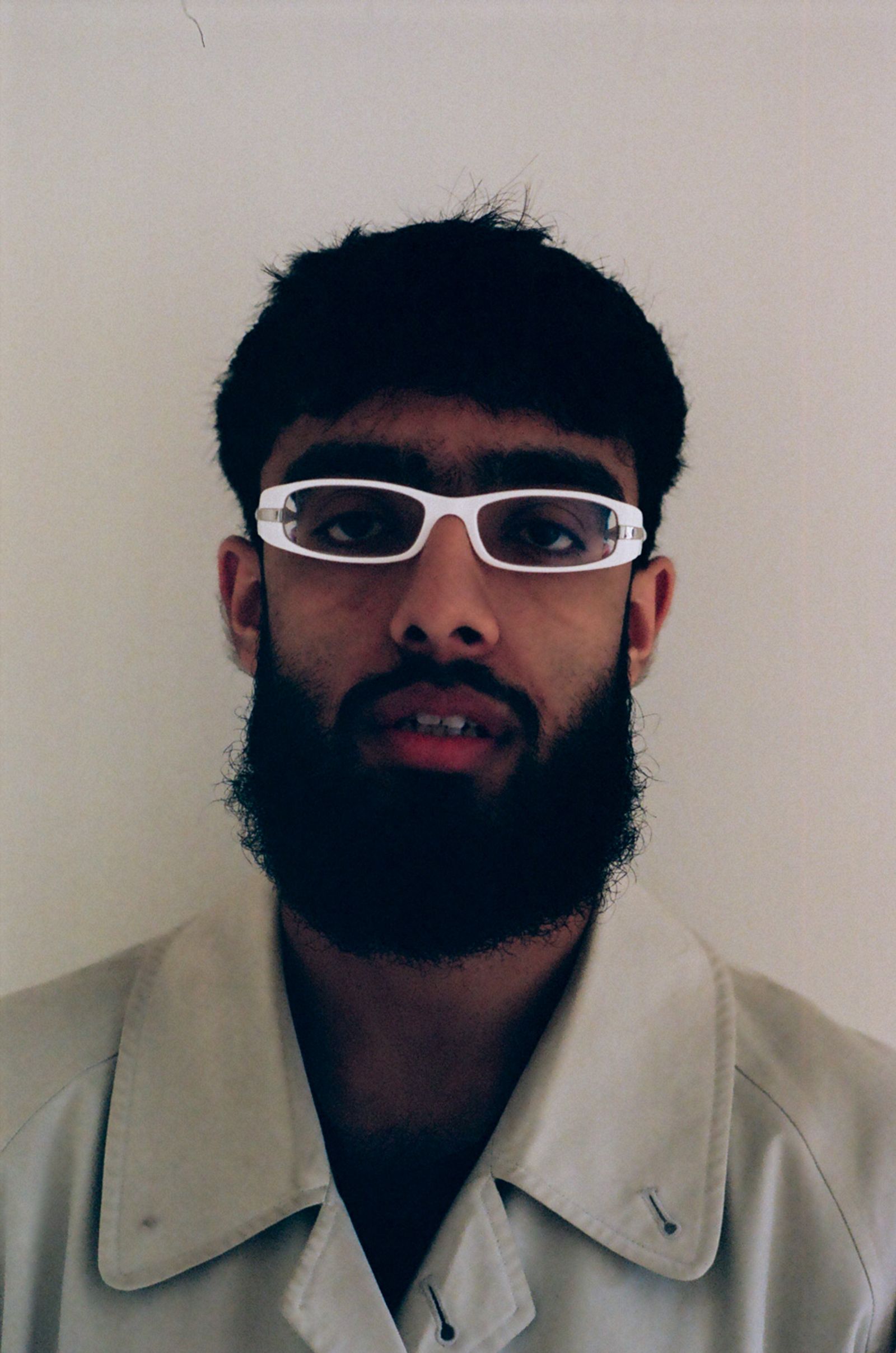
“I’m on the border of fiction and reality, right before fiction becomes reality.”
Sarra: So I first came across your work through an article you pitched to Dazed MENA on Islamic Brainrot, which was a searing critique of the algorithmic financialisation of religious life. Your work often lives here, using spirituality and Islamic thought as a vector for understanding the complex intersections of technology, philosophy, and economy. I’m curious where these interests first began developing and why? How would you describe your practice?
Raza: My dad had a very spiritualized relationship with money, and so does Pakistan. Historically, in the Muslim world, money has been something that's spiritual. It kind of made me interested in looking at the world today, seeing how, in the West, people also have an equally spiritual relationship with money, and how this might have some crossover.
In my work, I’m trying to make objects that don’t exist yet but probably could. If you went to a Muslim tech convention next year, or you went to like an Islamic toy store in two years' time, this is the type of stuff that you'd see. 90% of the time nowadays, I get messages on Instagram, or whatever, of people sending me real products saying, ‘yo, this is like, this is like one of your artworks’ or ‘this is like straight out of like one of your exhibitions’, and it’s just a real product that actually exists.
I’m on the border of fiction and reality, right before fiction becomes reality.
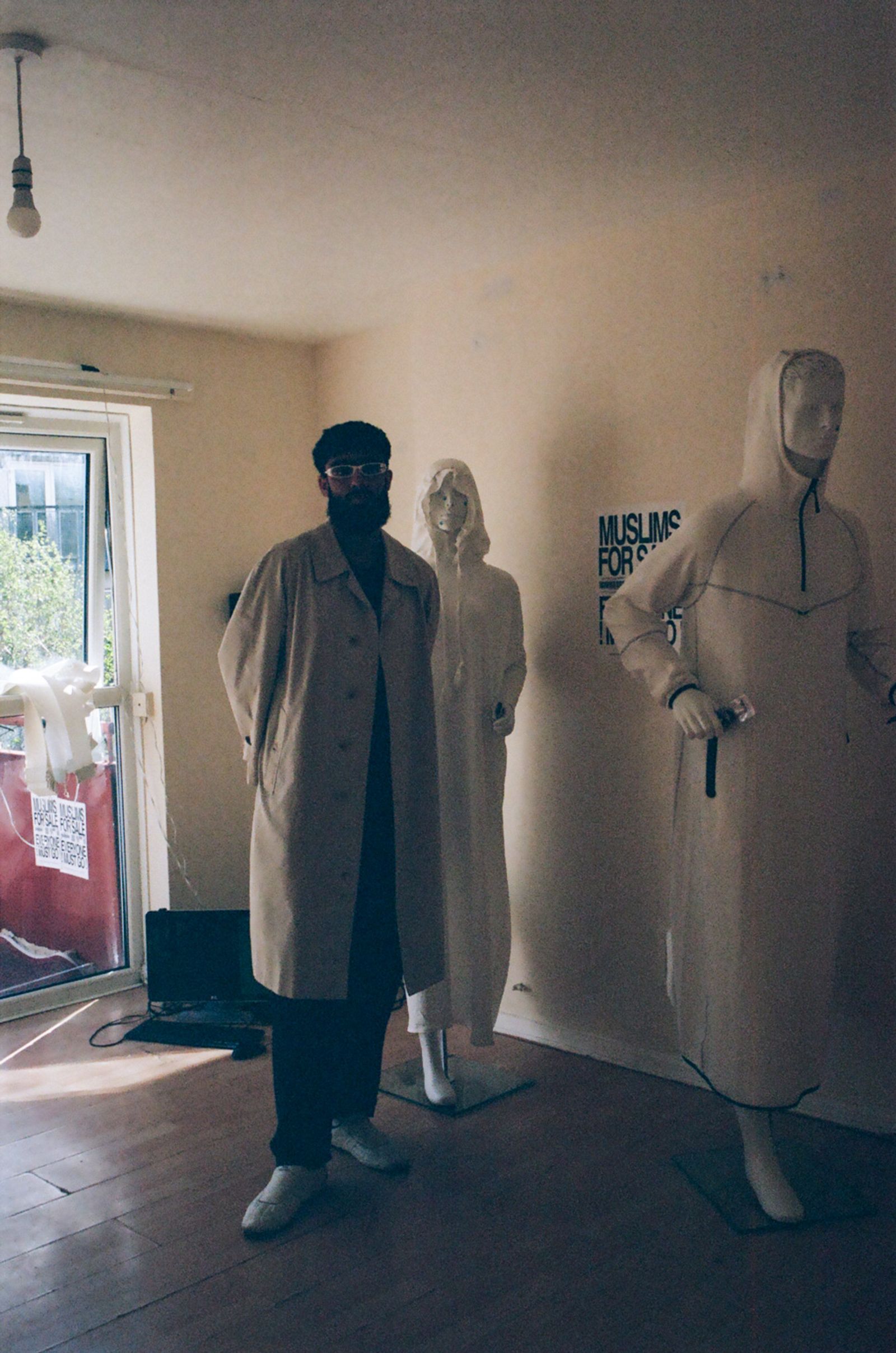
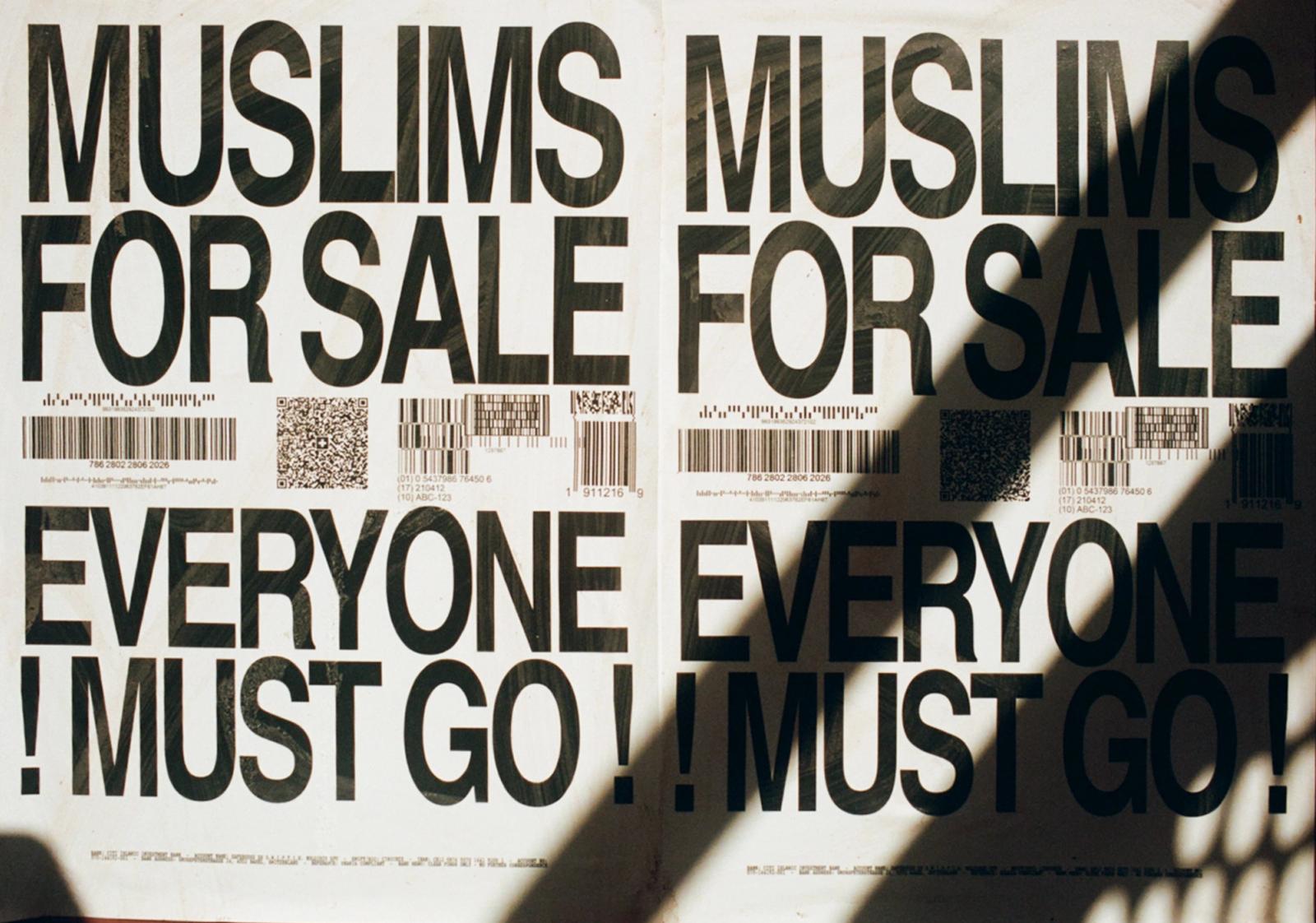
Raza Tariq, “AZAR’S IDOL SHOP” (MANNEQUINS, NIKE TECH THOBE, HOODED ABAYA, STARFACE STICKERS, NUMEROLOGICAL VERSE BARCODE PRINTS ON A3 POSTERS, WESTERN UNION DIGITAL TASBIH COUNTER, WESTERN UNION RAMADAN PAMPHLETS), 2026. Photo by Yusef Jack Tothill.
Sarra: In your work, when you think about money, the sacred and the profane is quintessentially blurred, in a way to comment on how nothing is sacred, but paradoxically, everything is at the same time.
Raza: That’s exactly it. I was having this debate with my friend last night in Paris about Fête de la Musique and the Grand Central Mosque of Paris. I went on the mosque’s website last night to check prayer times, and on the homepage the fi rst thing that came up was, ‘Grand Central Mosque of Paris, Fête de la Musique.’ They had their own Fête de la Musique, which was like these traditional Algerian or Tunisian Qasida musicians. The guy I was with found it so bad. But I was like to him, ‘Bro, I think it’s funny.’ He was like, ‘What do you mean?’ I think there being a Muslim halal version of Fête de la Musique is super interesting. Is it a cultural thing, you know? For him, though, he didn’t think it was, as it’s a faith space where you don’t want any other things to permeate your imagination. You want to protect yourself.
Sarra: Is there a sense of a fabricated sanctity to these religious spaces that keeps them bound to the traditional in a way that overlooks how religions, like Islam, have historically long had a religious economy?
Raza: I think we have the concept of the Zahir and the Batin (the seen and the unseen), and I think people just worship the Zahir. They only have a familiarity with the seen realm, and that’s what they think is sacred. If I’m described as an Islamic artist, or introduce myself as such, people assume I do calligraphy, play the oud, or create traditional craft-based artwork. But my artwork has nothing to do with any of that, because what is Islamic?
When you actually dig into what a lot of Muslims think is Islamic, it's a series of aesthetic tropes that have nothing to do with Islam's ideas. In actuality, what Islam is propagating is a nameless, faceless, placeless God which permeates everything, which you can't actually describe or assign any aesthetic value to. So really, all these material forms that we think are sacred, which we need to protect, I think, are just cultural angst.
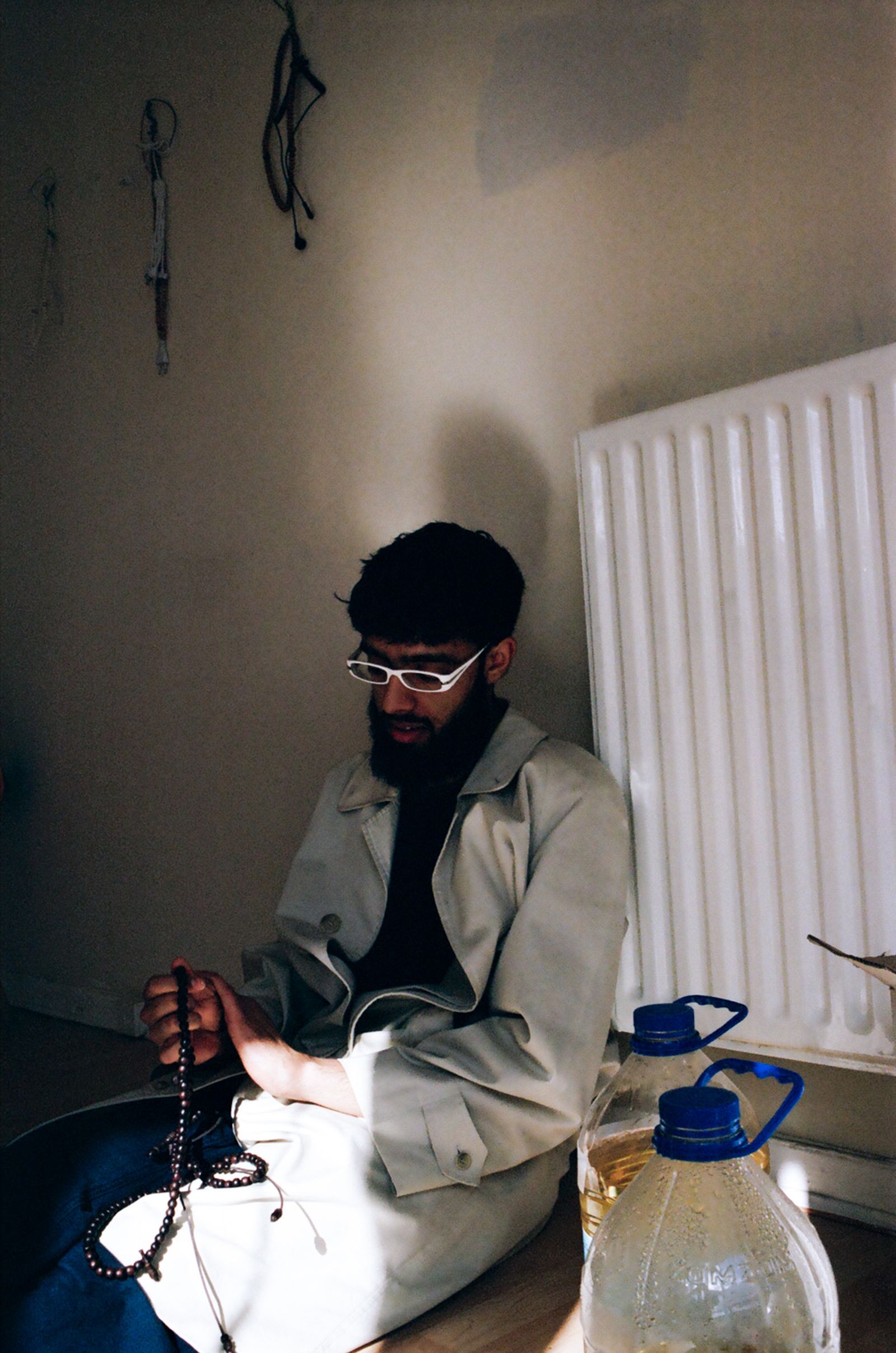
Raza Tariq. Photo by Yusef Jack Tothill.
Sarra: I think it also comes from the contradiction of having this, as you say, nameless, non-aesthetic doctrine woven into Islam, but then working within fi nancial, social and cultural systems that are bound to the material and also identify themselves through taxonomy. Your work is very much about provoking that paradox, especially when you talk about transhumanism and drawing the comparison between Islamic thought and these Silicon Valley tech bros. I’d love to know how these thoughts have developed and how you’ve channelled them into your upcoming show or the one you have now, ‘S.W.I.F.T.I.E.’
Raza: On both sides there’s the Zahir and the Batin. There’s the Zahir, which is the pills, wellness, Erewhon shakes and all of these aesthetic rituals. Then there’s the Batin of it, this nameless Ray Kurzweil singularity paradise which lives forever and exists everywhere, but you can’t understand what it is. It’s interesting to me how this symbolic idea of the seen and the unseen eventually permeates all ideas, especially when it comes to transhumanism and money, because they have such potency.
To me, the funniest thing is, and I think all of my work, the sculptures and everything, is how kitsch the visual aesthetics end up becoming of something that is supposedly unseen, permeating and transcendent. For something that is such a grandiose idea, whether it be money, transhumanism or religion, the optics often end up becoming quite trite, commercial everyday aesthetics.
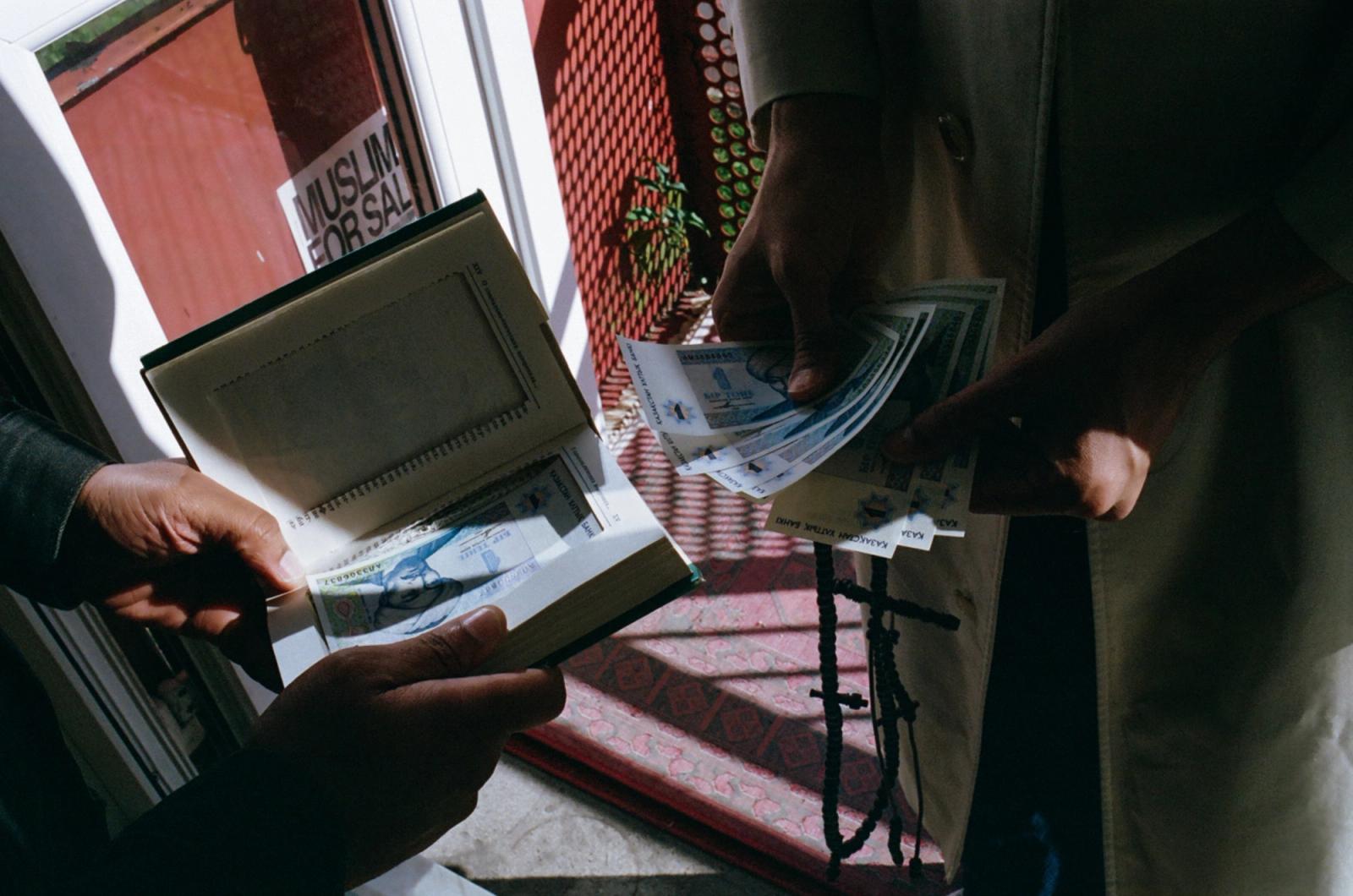
Raza Tariq, “S.W.I.F.T.” (70’S SOVIET COPY OF AL FARABI’S MATHEMATICAL WORKS, 90’S AL FARABI SOVIET POSTAL STAMP, 1992 KAZAKH TENGE NOTES), 2026. Photo by Yusef Jack Tothill.
Sarra: Have you had any backlash for how you treat spirituality in your work?
Raza: My whole life, and I think part of my rebellion in making work that became more subversive over time, is to do heavily with the fact that wherever I've gone, religious people and irreligious people have never really accepted me either. Both groups have always kind of thought I was a bit weird. So it's led me to this place where I feel like I just have my own thing now, you know? And I've been joking on my head, Tariqa Raza'i or something like, in the past few days, I feel like I'm literally just losing my complete connection to all these groups or like names, you know? Which I think is quite Islamic.
When I was younger – and we see this in the creative world also – a rapper will go through a cultural religious awakening, and they're Salafi , you know? The most accessible version of Islam in metropolitan areas is Salafi sm or a version of it. When I was younger, and I had ideas about art, I was going through that thing of like, oh, ‘I can't say this, I can't do this,’ or the traditional archaic ways of looking at music as not permissible. But as soon as I outgrew that and saw how, for example, a traditional Sufi way of seeing it enables art, enables musical expression, it liberated me in one step.
Sarra: Is there a sense of tech-optimism when you approach your work?
Raza: Apathy is dangerous. This is why I love the work of Ruba Al-Sweel and what she and Al Hassan Elwan are doing at POSTPOSTPOST, as well as the larger group of internet thinkers they are part of. With all of them, I hear their frustrations: they say everything is true, everything is everything, everything is nothing, stop taking everything so seriously, but also that everything is serious. I get exactly what they mean by this internet-ifi ed way of looking at things, but I think the fi nal conclusion, without certain anchors, leaves you apathetic and maybe a little nihilistic. I think this is dangerous, not for them, but when you give in to nihilism, that is also black-pilled incel culture on the other side of the spectrum.
“Art is about healing culture and the heart, and you can't compute healing; yet, Silicon Valley thinks it can... You can't intellect your way out of some of these problems; you need to heart your way out of your problems”
Sarra: Where does art fit into this for you?
Raza: Art is about healing culture and the heart, you know, and you can't compute healing; yet, Silicon Valley thinks it can. If you look at all of these like cult leader type ‘thinker’ personalities, they'll be like, ‘oh, depression isn't real, psychology isn't real’, you know, you need to read Heidegger and understand the problems with neoliberalism and capitalism and then like defeat it with your intellect. But you can't intellect your way out of some of these problems; you need to heart your way out of your problems.
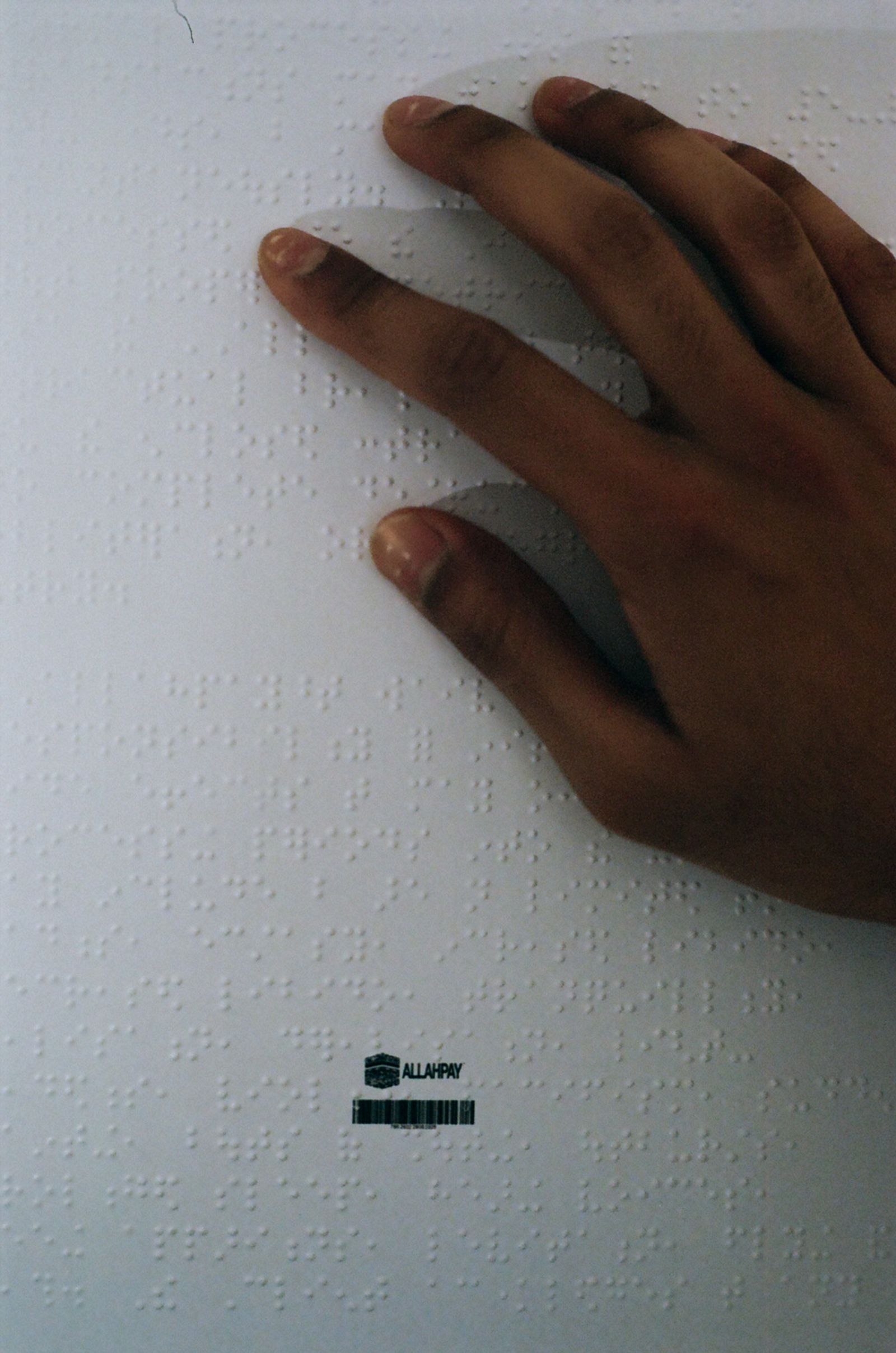
Raza Tariq, ALLAHPAY™ (TERMINAL, BRAILLE CONTRACT, BIOMETRIC DATABASE). Photo by Yusef Jack Tothill.
Sarra: Your recent show ‘S.W.I.F.T.I.E’ had a lot of heart, I think. Interestingly, the show was designed in direct response to its venue. Meadow is a project space run by Jarelle Francis – an assistant curator at Tate and former Green Party activist – out of his own apartment, after he was forced out of Deptford's Enclave Projects (where most neighbours, Studio/Chapple, Lake, XXjira Hill, are backed by private wealth he doesn't have). The fl at is now under threat of demolition by the council. Can you tell me a bit more about this and how the space itself became a precursor for some of the ideas you explore in the show?
Raza: The art world has its own form of avoidance as well. The art world has its own form of nostalgia that it's practising with this white-cube project-space gallery model, and we’re all pretending that we’re not also a religion, and we’re not also doing our own pilgrimage every time we go to these openings.
There's a certain hope here that, like, ‘oh, yeah, I did a show in this project space in the Enclave in Deptford. Then I'm going to get picked up by this like mid-level gallery. Then I'm going to be in the discount-booth Focus section of Frieze, and I'm going to be able to post my installation pictures.’ It’s okay; I suff er from the same anxieties.
However, we have to understand that this is a failing culture, and it won't change until we change it.
Sarra: How did, if at all, some of these thoughts become precursors in S.W.I.F.T.I.E?
Raza: By accident, it became a model for this Cosmotechnics, this Islamic Cosmotechnics thing. When Jarelle asked me to do the show, I was thinking, wow, like white cube LED lights, you know?
When he told me, ‘let's do it in my apartment because, number one, I can’t aff ord it, I have to leave that space, I can't aff ord it, and also I might get evicted at any time, so let's make it easy to pack up any moment,’ the realities of what I live with on a day-to-day basis hit me. He lives actually not too far from where I live, and it kind of made, I think, my biggest realisation in life, and this directly stems from my dad, to go all the way back to that, that the big imaginary saving the day is not coming. You live in who you are, in your body, and in your home right now.
Sarra: The only way out is through.
Raza: Yeah.
Sarra: I find it interesting how people perceive spirituality as something grandiose when in reality, being faithful, committing yourself to let’s say, a Sufi way of life, is more mundane and bound to the everyday.
Raza: When you read Sidi Ahmad Zarruq and a lot of Sufi manuals, actually, most of them are quite boring. No one wants to admit that.
It reminds me of technology, the way we use our phones. I think we have a very disciplined regimen with our phones. You know, if you were to categorise our phone usage, our screen time, and our discipline with using technology unconsciously, it's got to the point where, like, we don't think it's discipline because we just do it. Then we talk about being in ecstatic states because of our phones, and people are going nuts, going into the mystical states we talk about in Sufi sm because they love the discipline of technology.
Sarra: I don’t know if they love it so much as they are programmed so effectively to abide by it.
Raza: To go back to Silicon Valley, it's a testament to how darkly successful and cunning the engineering of their products is.
If you look at Freudian psychology – this is what my book I'm working on is going to be about – is that there’s a moment of hijack.
You know, Isaac Newton was a very occult and esoteric guy, but he was also a materialist. Also Francis Bacon, all these guys just basically slowly started going, imagine if we change this to like numbers and letters and quantity and all this stuff. But actually, they never changed the infrastructure – it's still initiation, ritual, discipline and ecstasy at the end of it. But they just managed to convince us to do it using diff erent tools, and to live someone else's paradise. That is the main thing I’m trying to say.
You know, I was looking at a scene on Twitter today, Flock cameras – I don't even know what these things are, but I'm seeing people post about them in America, or even the Meta glasses ad with Kylie Jenner; they are just preparing us to live in a paradise that's theirs.
[Turns the camera to a bin on the side of the road in Paris] Look at this bin, you know the 70s surveillance fi lms where they are watching the bin, and they’re like, ‘they’re there, they’re there,’ and they go in and fi nd a camera in there or something, that’s what technology is becoming. It’s becoming this thing where it’s so mundane and everyday that you feel suspicious about the everyday object, and it programs your behaviour to behave as if you’re being watched, very much in the Foucauldian sense.
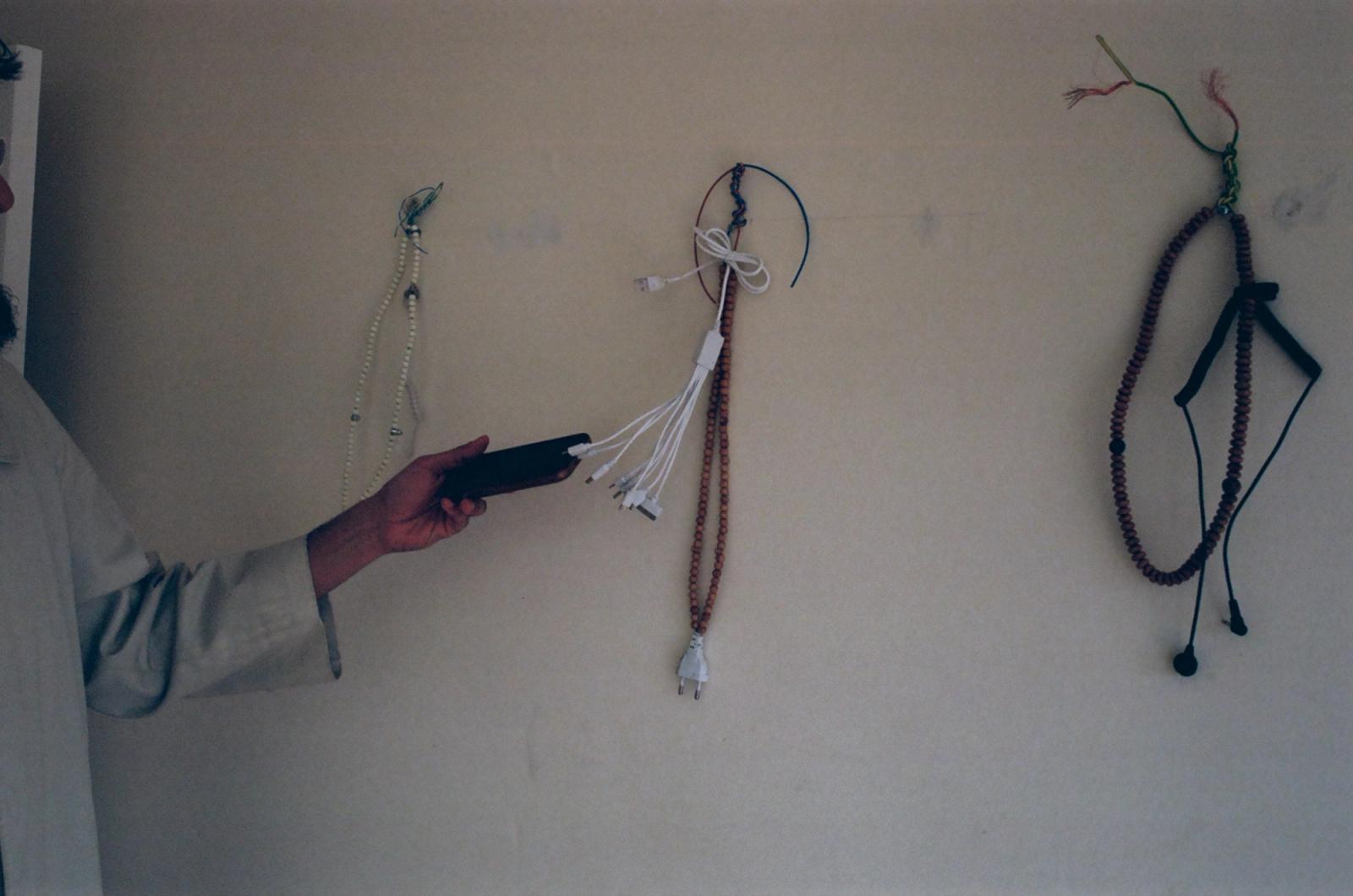
Raza Tariq, “WIRE TRANSFER” (PRAYER BEADS, COPPER WIRING, ETHERNET CABLE, EUROPEAN AC PLUG, MICROPHONE, SECURITY EARPIECE), 2026. Photo by Yusef Jack Tothill.
“I don't see myself as the solution, but I see us, collectively, as the solution. I believe the more people we can aff ect with our way of thinking, the more we will actually match Silicon Valley. We can be our own Silicon Valley.”
Sarra: What are you looking forward to exploring in the future?
Raza: So I just opened a commission with arebyte Digital Art Centre; it's not an exhibition, but it's basically the product of a residency I was doing with them for the fi rst half of this year. It’s 11 interventions around ATMs in London, considering ATMs as sites of altars, or as points of worship or departure. It’s got this parallel gamifi ed Pokémon Go-style map where you can navigate around there and go to each one, on diff erent quests. You have to have this necklace talisman to even access the map and fi nd the sculptures and interventions.
It's an artwork called PURE PROFIT, but it's so complicated; it spans game, quest, geocaching, installation, there's a lot to it. In a sense, you can’t capture it with one object, much like this network of objects around us, serving this cohesive, unseen system. Benjamin Bratton talks about a Stack of sensors, cameras, cars and phones around us that form one cohesive realm on earth. This is like another Stack.
I think that we've lost a little bit of scale and a sense of scale or grandiosity in our generation of artists right now. Today, everybody just wants to make these kitsch little sculptures that look nice on a small project space wall in Paris during Fashion Week, or make stuff to write a little bit of copy about and hopefully sell to, like, a collector who has a job in tech and is kind of interested in art. I think I want to bring back stuff that's challenging.
I don't see myself as the solution, but I see us, collectively, as the solution. I believe the more people we can aff ect with our way of thinking, the more we will actually match Silicon Valley. We can be our own Silicon Valley.
We can create our own through work that's equally ambitious and often much cheaper. Sam Altman needs like 60 or 70 billion just to do the most basic thing. But I, on my Meadow show, I had 500 pounds, and I took over a flat.
Being able to do a lot with a little right now is my key goal. I’m realising it takes very little actually to compete with people who are a lot bigger than you. Most people who are bigger than you are very wasteful. I just made my new fi lm for basically nothing. I found the budget a week before shooting.
But yeah, I've made a fi lm as well. So you asked me about my next project, but yeah, I need to – basically, I'm gonna dedicate the rest of this year to writing that book and to a new fi lm project, which is in development. And yeah, I'm up for a few residencies, but we'll see what happens. I don't know if I'm gonna get that.
PURE PROFIT remains open until 2nd August at arebyte Digital Art Centre, and SAFEHOUSE DE S.W.I.F.T.I.E., the artist’s solo exhibition, continues until 25th July at Meadow.

Comments
Leave a comment