

“If war repeats across history, what does it mean to keep giving it a shape?”
H.E. Morris' Songs of War, opening on the 4th of June 2026 at LBF Contemporary, asks how we tell the story of war through trauma, simulation, the collapse of linear narrative, and the negotiation of conflict inside the painting itself. On Saturday 6 June at 1PM, a group of writers will respond to the exhibition in a reading at the gallery. Ahead of the reading, I want to ask a question that her work kept producing for me: if war repeats across history, what does it mean to keep giving it a shape?
The ethics of war has been a serious philosophical preoccupation for most of recorded history, and an unusually productive academic sub-field for the past thirty years. Since Michael Walzer's formulation of Just War theory in the 1970s, philosophers have worked systematically through the conditions under which armed conflict can be justified: jus ad bellum, justice in going to war; jus in bello, justice in conducting it. Post-Cold War humanitarian intervention doctrine destabilised some of those assumptions and the 9/11 period destabilised it even more. Debates about preventive war, asymmetric conflict, torture and the legal status of unlawful combatants have kept the field in productive crisis ever since.
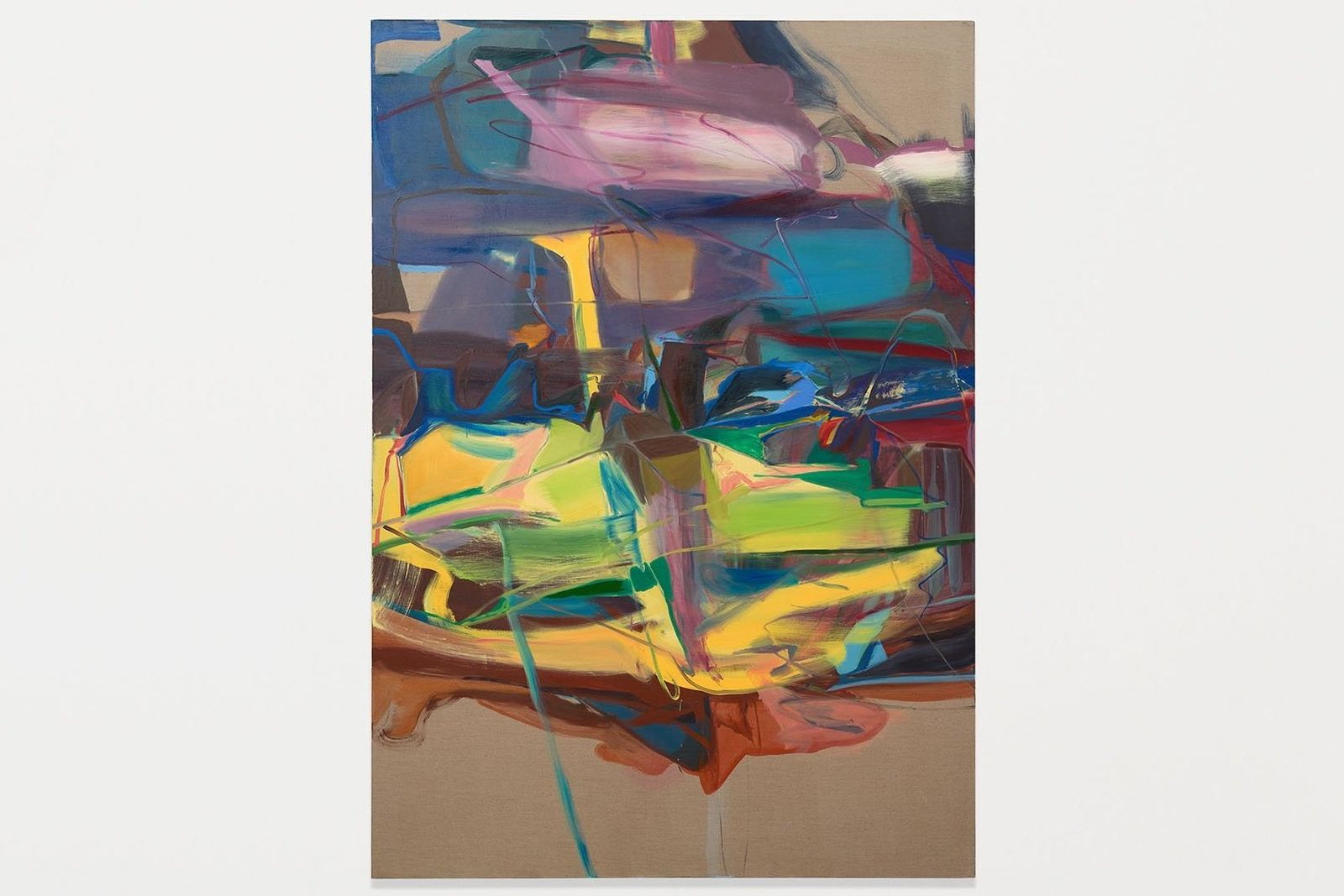
H.E Morris, A Secret Held, 2025.
However, war philosophy and its concepts don’t just affect policy-makers or people living in active war zones. The doctrine of double effect, developed by Aquinas to distinguish intended from merely foreseen harm in combat, now does regular work in medical ethics in arguments about palliative sedation and euthanasia. The Non-Aggression Principle, a cornerstone of libertarian just war thinking, has been imported wholesale into both sides of abortion debates. Proportionality and imminence, the twin tests for legitimate self-defence in war, now structure Stand Your Ground legislation across the United States. Closer to home, the ticking-bomb hypothetical, which was originally a thought experiment about torture in wartime, has now migrated into debates about PREVENT, police conduct, pre-crime detention, and predictive surveillance technology. It is natural, therefore, to think about how war and the ethics of combat are translated into the cultural sphere.
“Clive Bell argued that art transcends war. In his view, the aesthetic experience lifts participants out of nationality, politics, and material circumstance entirely.”
Writing at the height of World War I in 1915, Bloomsbury art critic Clive Bell argued that art transcends war. In his view, the aesthetic experience lifts participants out of nationality, politics, and material circumstance entirely. Artists, he wrote, are the vestals of civility, tending the flame while everyone else shoots at each other. It is a seductive argument and the art world has been living off it ever since. The transcendence claim is also, conveniently, a way of not asking where the money comes from.
The story of how war enters the art world begins well before 2023. Frances Stonor Saunders documented the most instructive case in The Cultural Cold War (1999), dissecting the CIA's covert funding of Abstract Expressionism as Cold War propaganda. Through the Congress for Cultural Freedom and a network of shell foundations, the US government bankrolled exhibitions, publications and touring shows positioning American painting as the apogee of Western freedom. Pollock, de Kooning, Rothko were deployed as cultural arguments (without their knowledge or consent) and European intellectuals who might have been persuaded by Soviet cultural diplomacy were instead dazzled by colour-field paintings and the mythology of Cedar Tavern.
The institutional infrastructure built during this period (the networks of galleries, critics, magazines and collectors who consolidated New York's dominance) may not have known about this instrumentalisation, but it certainly didn’t resist it. War art profiteering is foundational to the institutional infrastructure we still work within.
“Institutions rely on conflict-adjacent programming because it translates easily to funding bodies, generates column inches, and positions institutions as politically engaged.”
Seventy years on, this ‘curation of crisis’, as I like to call it, has become a standard of the Western art complex. Conflict in general has become a reliable biennale theme. Venice has returned repeatedly to questions of displacement, occupation and post-colonial violence; Documenta has been defined, in recent editions, by its engagement with struggle and resistance; the Turner Prize shortlist reliably features artists working with refugee testimony, protest imagery, or the material consequences of war. The institutional appetite (as opposed to the work of individual artists - I am by no means criticising artists that use or depict war as subject or catalyst) relies on conflict-adjacent programming because it translates easily to funding bodies, generates column inches, and positions institutions as politically engaged without requiring them to take positions on actual political questions. Platform and extraction are, naturally, different operations, yet the art world conflates them constantly.
A recent example of this is Otobong Nkanga’s temporary exhibition at the Musée Cantonal Des Beaux-Arts Lausanne, I Dream in Colours. The show was in part dedicated to critiquing the mining industry. Her video work documents her visit to Tsumeb in Namibia, a former mining site transformed from copper-rich hillside to blasted crater by German colonial extraction. In the piece, she sings to the wounded earth as an act of appeasement. Audemars Piguet, whose watches require the mining of metals from sites not entirely unlike Tsumeb, sponsored the institution that exhibited it. Only one of these facts will have any material consequence.
“War, whether it be martial, cultural, ecological or pharmaceutical, has always been art's most reliable subject. The question of what artists owe to it has produced different answers across five centuries.”
Similarly, the Sackler family's philanthropy funded galleries, museums and universities for decades while OxyContin addiction killed hundreds of thousands of Americans. BP's support for Tate's free entry programme, terminated in 2017 after sustained activist pressure, ran concurrently with the company's expansion of fossil fuel extraction. This is, and has been for a very long time, a primary and worrying exchange. Cultural institutions need money. The industries most in need of cultural validation (and forgiveness) have money, but often only through war of some kind or another. War, whether it be martial, cultural, ecological or pharmaceutical, has always been art's most reliable subject. The question of what artists owe to it has produced different answers across five centuries, and the tension between them is still live.
The oldest model is war as elevation. Greek sculpture used the ideal martial body as a vehicle for exploring civic virtue and divine favour simultaneously. The Doryphoros, Myron's Discobolus, the friezes of the Parthenon are all works in which physical combat becomes a metaphor for the ordering of the cosmos. This triumphal tradition ran forward through the centuries all the way up to the neoclassical revival of the eighteenth and nineteenth centuries - think Velázquez's The Surrender of Breda or Jacques-Louis David’s staging of Napoleon. The artist here is a a glorifier in service of power.
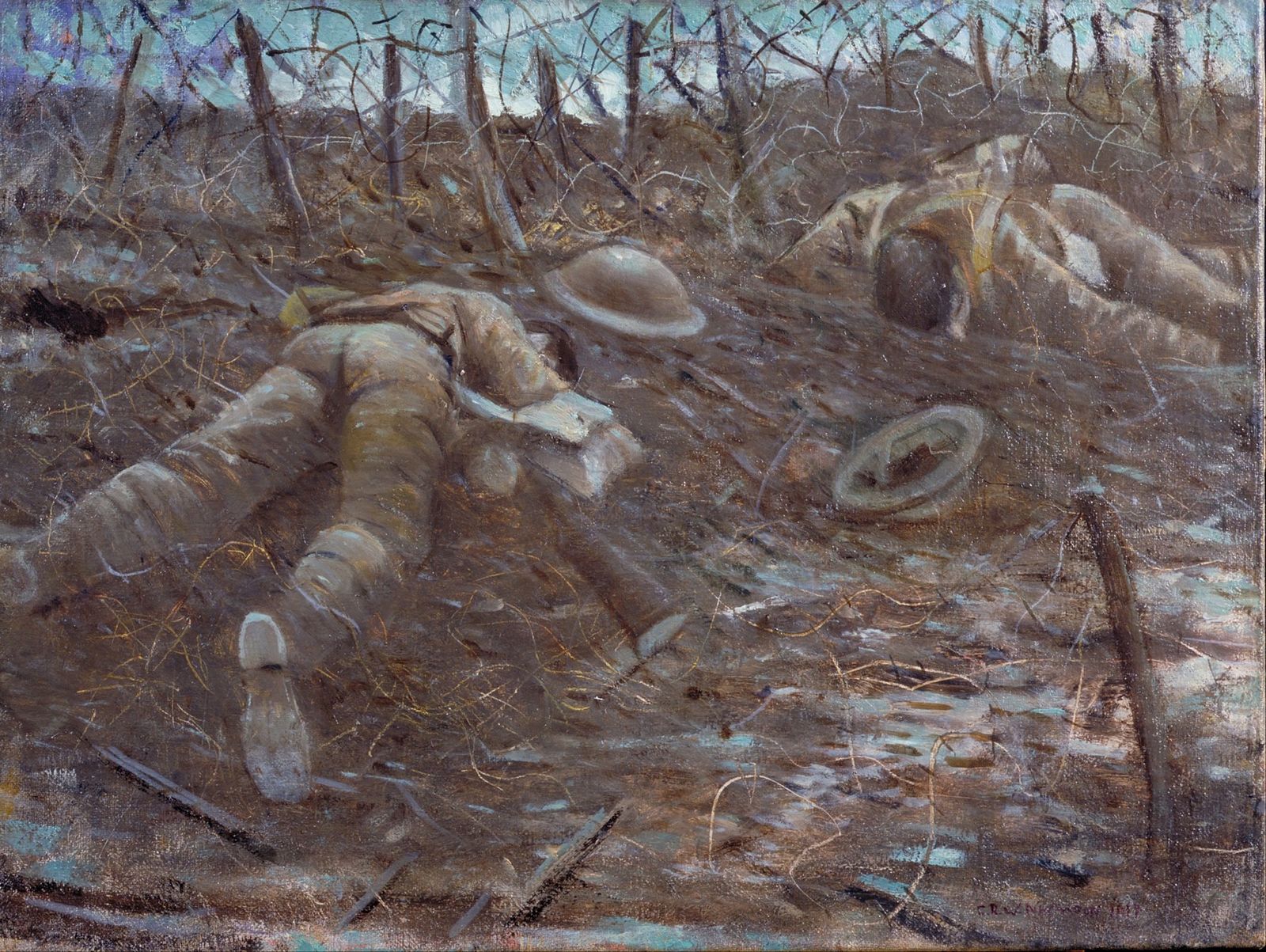
CRW Nevinson, Paths of Glory, 1917.
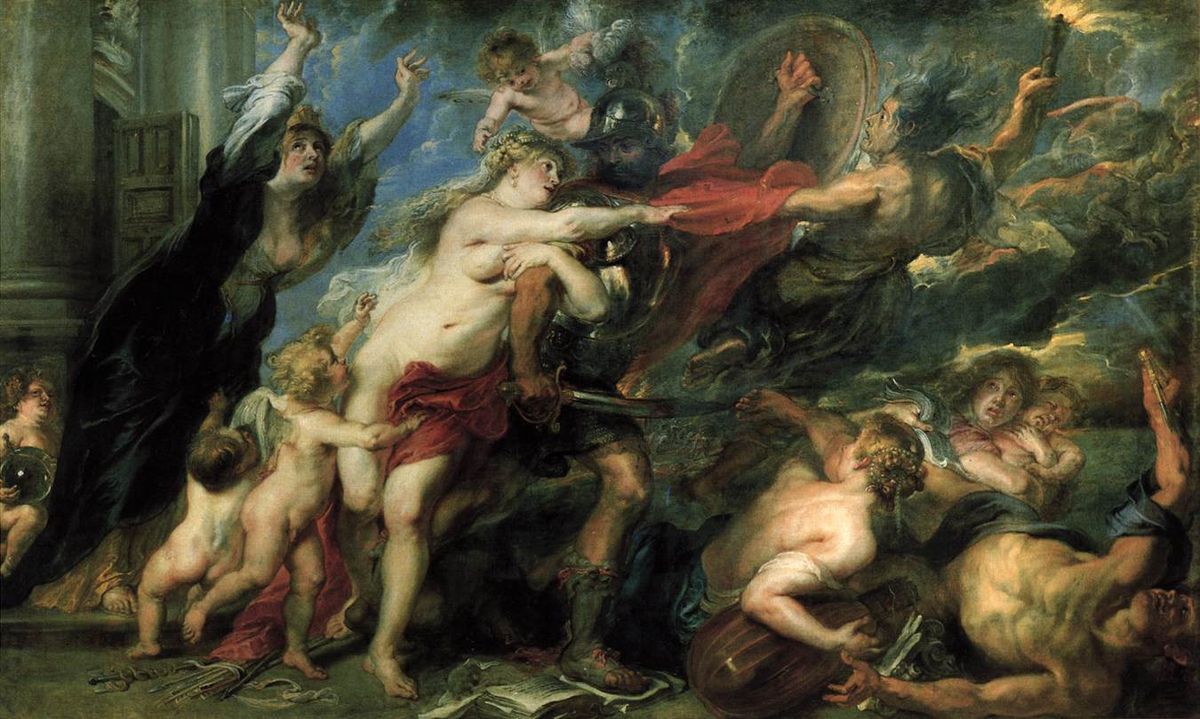
The counter-tradition is almost as old; artists have depicted the devastation of war just as much as its glories. Jacques Callot's Les Grandes Misères de la guerre (1633) documented the pillaging, civilian massacre and execution of the Thirty Years War, and Rubens's The Consequences of War (1638) is explicitly anti-war: Mars is dragged toward battle while a lamenting woman, representing Europe, reaches after him. These works may have existed at the margins of a culture that still largely understood war as ennobling, but they existed nonetheless as a formal objection to war.
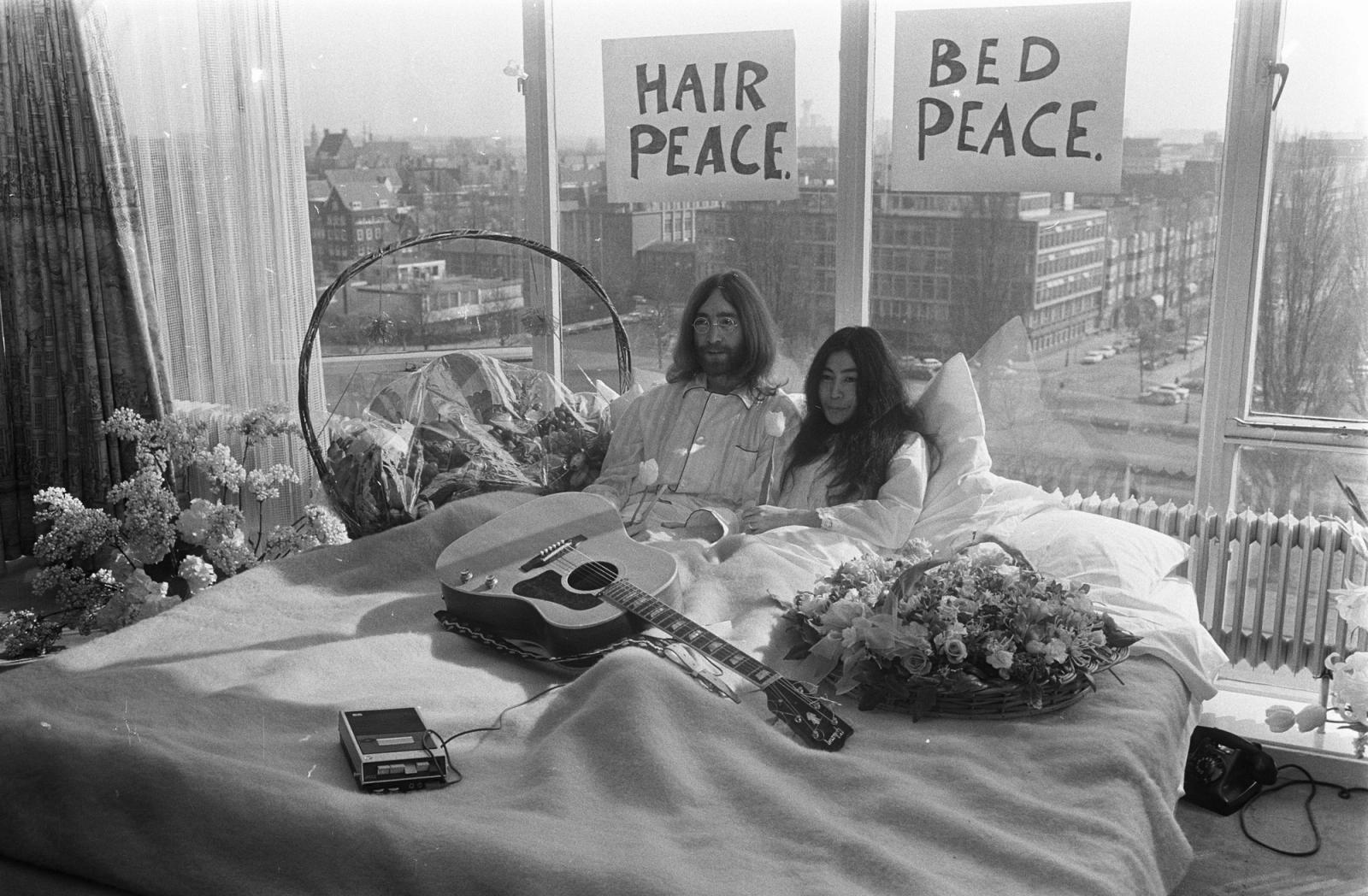
By the start of the twentieth century, the balance had shifted, with the First World War producing a definitive break. Nevinson's Paths of Glory (1917), showing two British soldiers dead face-down in Flanders mud, was censored by the British government because it. Paul Nash and Otto Dix's works similarly depicted the trenches as a vision of hell indistinguishable from the medieval imagination of damnation. The formal violence of Picasso's Guernica (1937) matched its subject's actual violence and has sort of become the twentieth century's shorthand for art's capacity to indict. By the late 1960s, artists began deploying celebrity attention as a counter-programming tool against Vietnam War coverage (on one end of the spectrum, Yoko Ono and John Lennon’s bed-in, which was largely seen as useless, on the other, The Art Workers Coalition's 1970 And Babies? poster which featured Ron Haeberle's My Lai massacre photograph overlaid with the text "Q: And babies? A: And babies." and was so brutal and the US government tried to suppress it).
Most markedly, however, was the rise of the wartime documentary tradition, which as an artform raised some of the hardest ethical questions of the century. The photographer's relationship to their subject is structurally extractive in a way that painting is not, but is also more direct in material reality. Lee Miller photographed the liberation of Dachau and then had herself photographed in Hitler's bathtub as a deliberate transgression of the aesthetic argument about war and its witnesses. Margaret Bourke-White, whose images of the Buchenwald survivors appeared in Life magazine in 1945, became one of the primary mechanisms by which the American public understood what the camps had been. When Evan Vucci photographed Donald Trump at the Butler rally in July 2024 he produced an image that I fully and utterly believe won him the election later that year.
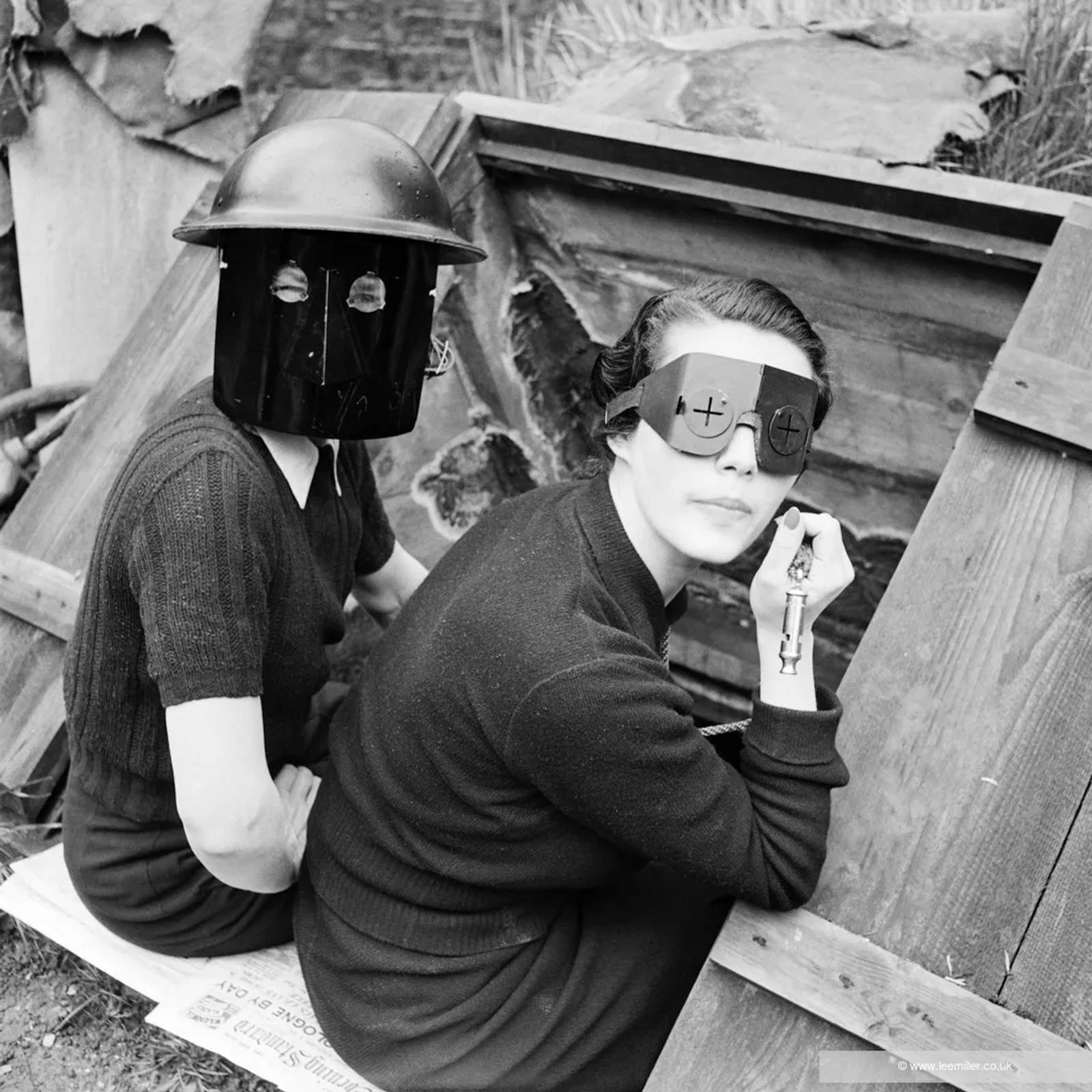
Lee Miller, Devonshire Hill, 1941.
“H.E Morris’ interest in the mythopoeia of war and the foundational myth-teller of Western conflict gestures at the same concepts Blake was wrestling with: the idea that the same energies produce the same conflicts.”
The ethics of war photography in particular tend to cluster around four pressure points. The first is complicity: does the act of recording atrocity make the photographer a collaborator in it? Judith Butler has argued that war imagery is never neutral because the state operates on fields of perception and representability specifically to control how images land and what political effects they produce, meaning the photographer is always already inside a system of power whether they intend to be or not. The second is intervention: when Kevin Carter photographed a vulture stalking a starving Sudanese child in 1993, the question that followed the image everywhere was why he didn't put the camera down and do something about it. The third is agency: Susan Sontag's formulation of photography as “chronic voyeuristism” in which the living person is replaced by a symbol, stripped of context, reduced to a representation of suffering for consumption elsewhere. The fourth, and most uncomfortable, is the counter-argument: John Berger's insistence that war photographs are essential to a global society because without them, atrocity becomes abstract and therefore risks becoming repeatable.
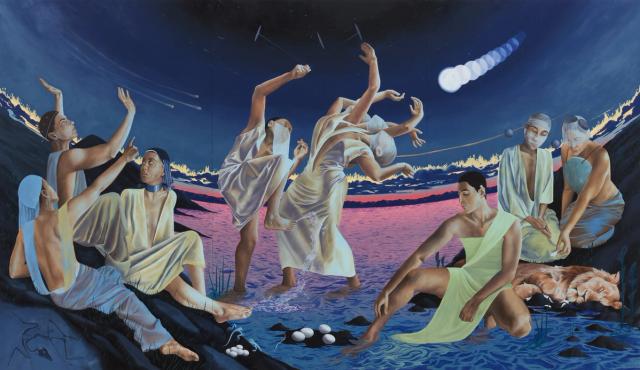
H.E. Morris's paintings do not resolve any of this. Her paintings are large-scale, abstract and fractured, figurative in the sense that their geometry implies some kind of material, embodied plane. The landscapes that emerge from the surface are not necessarily representations of specific conflicts, they are war as condition, a recurring formal problem. Her show's title refers to William Blake's Songs of Innocence and of Experience (1794), subtitled Shewing the Two Contrary States of the Human Soul. Blake’s mythology is structured around a dialectic that sees innocence as a protected, pre-lapsarian condition and experience as the fallen state produced by institutional violence, labour, repression, and grief. Blake understood the two states as genuinely contrary, with each containing what the other cannot; conflict must necessarily run through both. In his mythological system, Orc, the spirit of revolutionary energy, is the force that wages war against Urizen's tyranny; but Orc's violence, unchecked, becomes its own form of destruction. Blake was writing during the American and French Revolutions, initially with enthusiasm and then with horror. Like Morris, he concerns himself with the ideas of war across history as historical repetition.
“Morris takes the dichotomous states of glory and grief, as Blake did, and asks: why does war always look like this, and why does it always come back?”
“I'm thinking of Homer and inhabiting that role,” she admits. Her interest in the mythopoeia of war and the foundational myth-teller of Western conflict gestures at the same concepts Blake was wrestling with: the idea that the same energies produce the same conflicts. Homer transformed the grinding, attritional violence of the Trojan War into a structure of fate, honour, grief and glory that the culture has been retelling ever since. Morris takes these dichotomous states, as Blake did, and asks: why does it always look like this, and why does it always come back?
The writers responding to Songs of War at LBF Contemporary on Saturday 6 June will bring their own answers.


Comments
Leave a comment