

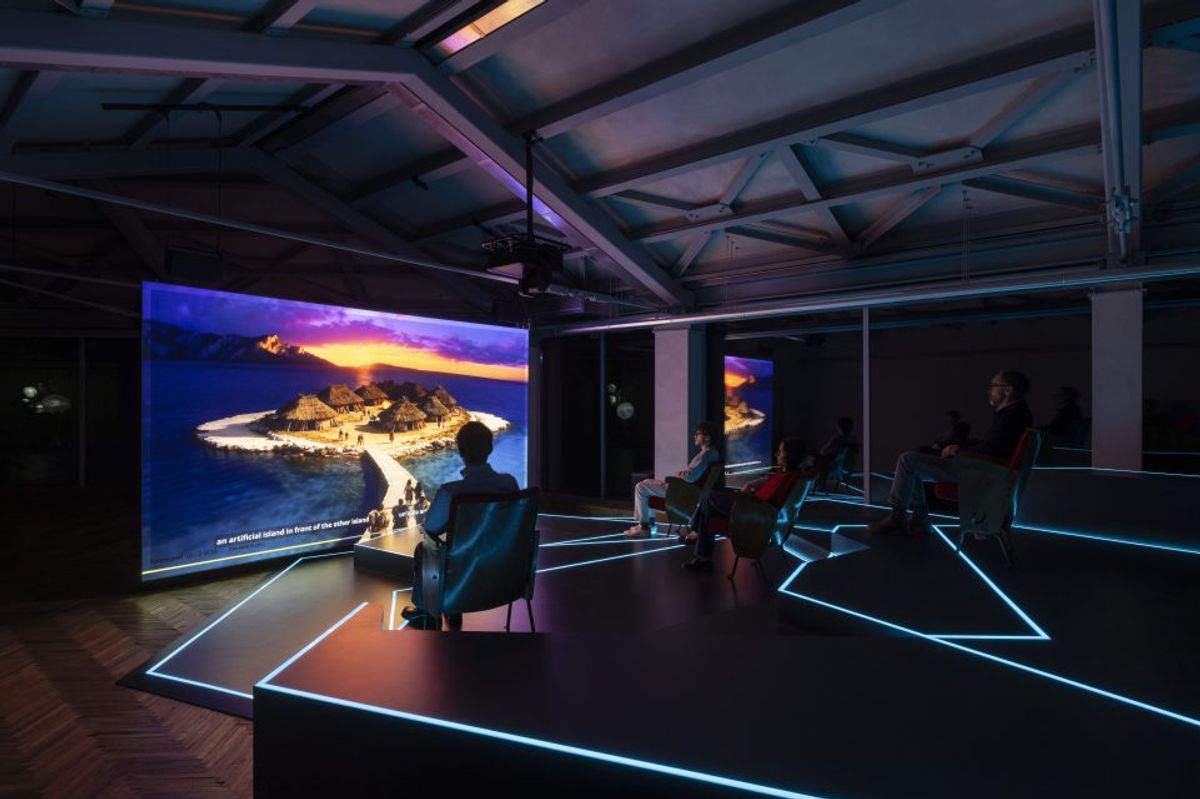

A monstrous wave terrorises a human settlement, swallowing everything in its path. The wave is digitally rendered, garish and gargantuan, more fantastical creation than natural disaster. This summary applies to the film that ties up the narrative of Hito Steyerl’s The Island, a site-specific exhibition currently showing at Fondazione Prada. It’s also the primary terror of Minions & Monsters, the latest installment in Pierre Coffin’s Despicable Me franchise. Steyerl’s wave is a shit-brown deluge ‘partly made of AI slop’. Coffin’s is thousand-eyed, Fanta-orange and similarly autogenerative. Last year, Twitter had a brief flirtation with B.O.B. from Monsters vs Aliens, a blue, gelatinous mass whose main power is his lack of a brain. Reaction gifs of the character were used to communicate a loss for words.
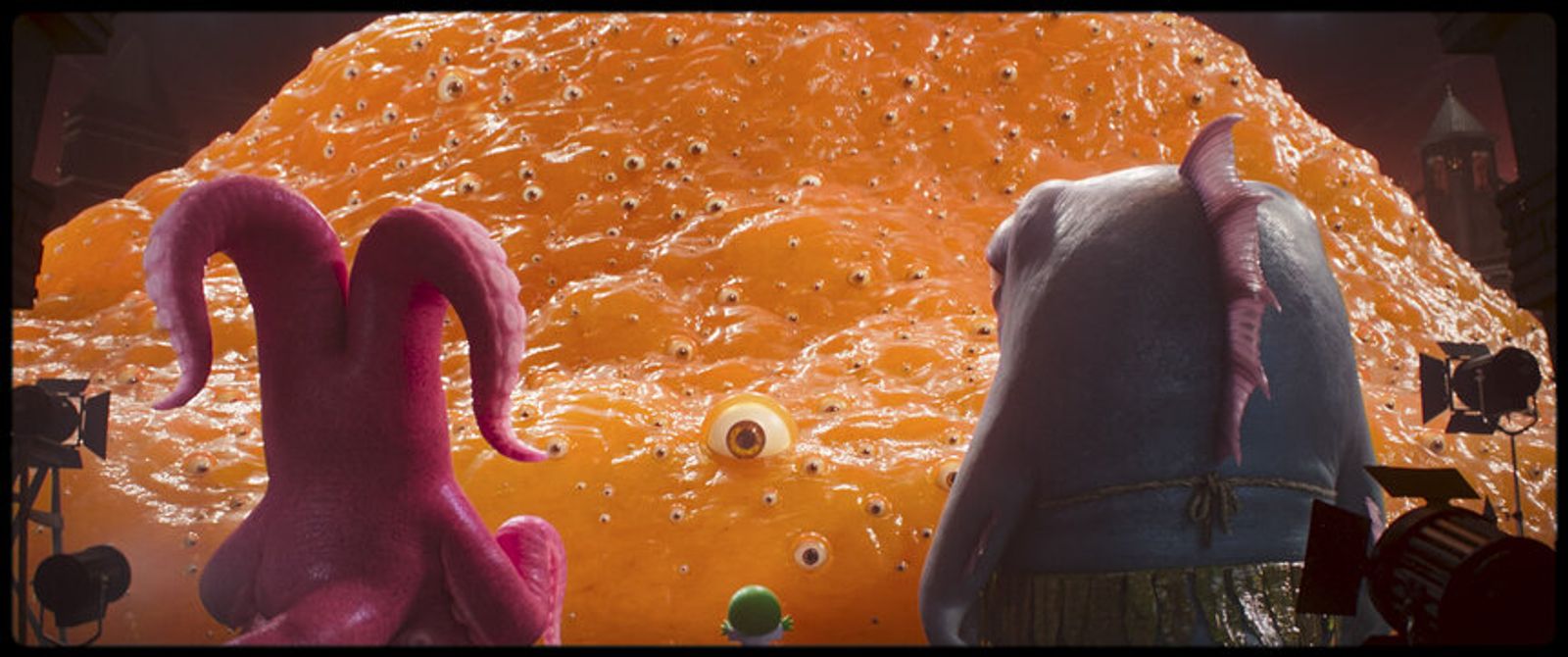
Illumination’s Minions & Monsters (2026), directed by Pierre Coffin. Courtesy of Universal Studios
Steyerl’s essay ‘In Defense of the Poor Image’ begins with the prophetic statement that “the poor image is a copy in motion”. No wonder, then, that the major anthropomorphised depiction of slop is a wave. A nascent, ever-chasing, boundless being of terror. An embodiment of emergent futurity. I come to the wave having trudged through Hokusai’s blue surge, diminishing Mt. Fuji, hiding among the animals on Noah’s ark. All of it seems to say: “We are afraid of being made smaller.”
“[...] the major anthropomorphised depiction of slop is a wave. A nascent, ever-chasing, boundless being of terror. An embodiment of emergent futurity.”

Bombardino Crocodilo. c TikTok/@armenjiharhanyan
The wave is a force of uncontrollable cruelty. It was once symbolic of God’s wrath; it’s now AI’s interminable joy. As political trends continue to favour extremism, the wave becomes a useful symbol of inevitability. It portends that what may currently stand could easily be swept away.
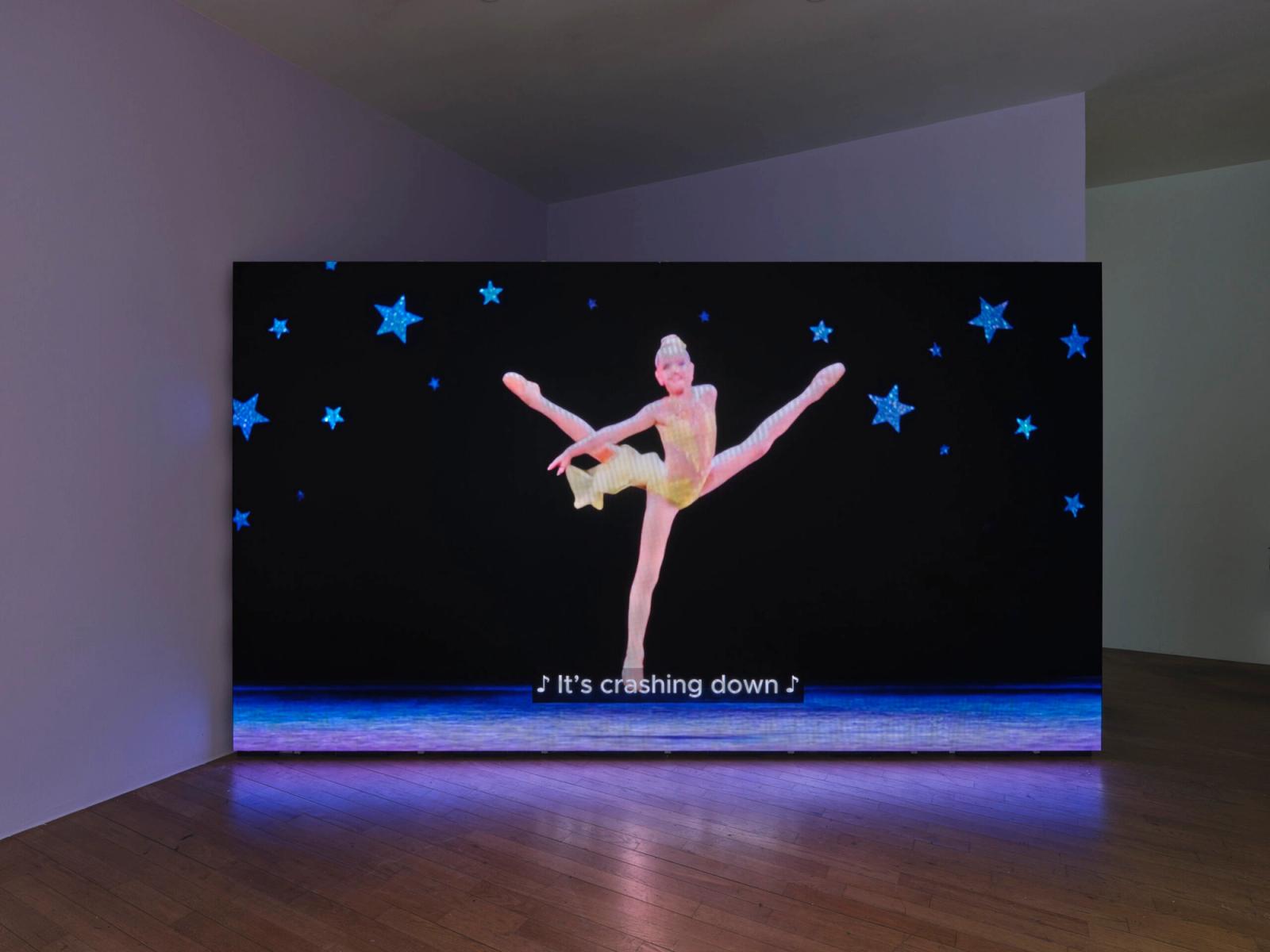
“StarQuest” by Maya Man, bitforms gallery. Courtesy of bitforms gallery
“AI has never been a Trojan horse.”
AI has never been a Trojan horse. But its usage appeared more innocent in the first wave of ChatGPT, as a dutiful machine for funny memes. That’s usually the first ‘defence’ people have about using it – that it’s fun. Maya Man taps into what AI does best in her video artwork StarQuest, which is mold those haunting baby-faces, manipulate pre-existent innocence. But even StarQuest is bolstered by its IP, transparency in process and multimedia addenda. One of the other popular ways of incorporating or responding to AI in visual art has been by translating its visuals in traditional media, like in the paintings of Sophie Jackson and Julia de Ruiter. In these cases, AI is a belligerent, if murky, servant, who has occasional quirks in their interpretation that can result in a pleasant surprise. A scribe occasionally guilty of blotting their pen.
“In these cases, AI is a belligerent, if murky, servant, who has occasional quirks in their interpretation that can result in a pleasant surprise. A scribe occasionally guilty of blotting their pen.”
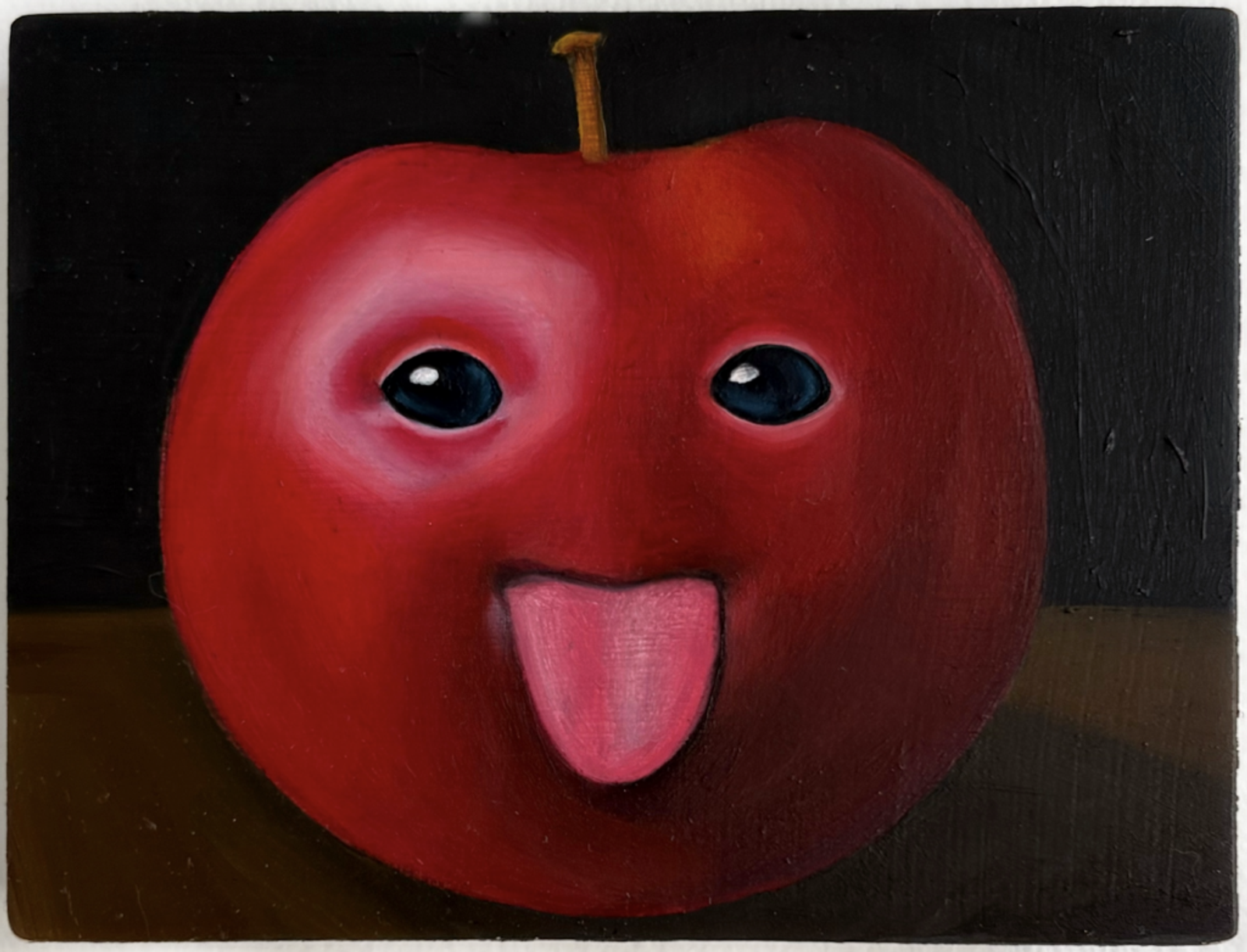
Return to Form by Julie de Ruiter. Courtesy of Overstandard.
I think reactions towards AI – whether that’s subsequent artistic depictions or the ideation around justifications for it – are going the way of myth. There’s the tech bros that espouse such feral fealty to alienating concepts that they perform a kind of sci-fi kayfabe. Then there’s the luddites that wish to return to analogue life, which occasionally tumbles away from getting off your phone to near-fascist nostalgic rhetoric.
At the heart of myth is a desire to make the world and its machinations seem coherent, even if the way about it is by making up a story. Even if that desire may seem impossible to fulfil, and therefore childish or immature to hold onto. After all, immaturity seems laced into how we approach AI, how we ask it to behave, how we address it. The aesthetics we have curated with AI have become ‘slop’ – low-quality, amorphous, baby-ish. I suppose that the traditional arts are driven by somewhat architectural impulses, hyper-concerned with the sophisticated, unitarian arrangement of disparate elements. AI’s impulses are dormant in comparison; its art is somewhat concerned with arrangement, but it’s more than happy with disparateness. If anything, it’s like a playful child, only less curious.
I’m really curious about the ‘play’ part of slop. At first glance it’s very Dada. “I let the vowels fool around,” wrote Hugo Ball in his Dada Manifesto. “Every page should explode,” wrote Tristan Tzara in his Dada Manifesto. There’s Nymphet Alumni’s term ‘SwagDada’, Steyerl’s ‘6-7 aesthetic’ and her incorporation of Italian brainrot memes in The Island.
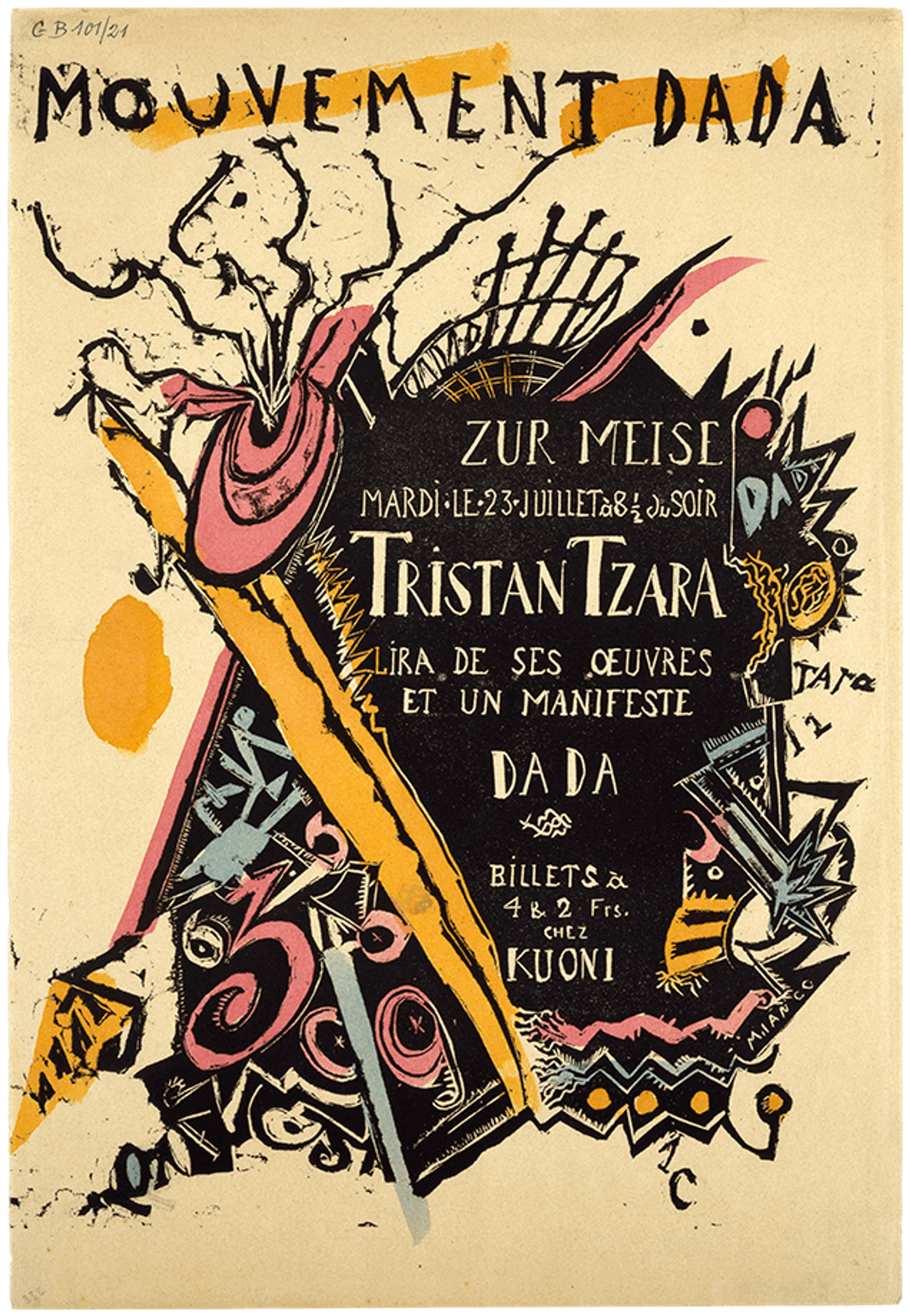
Poster for the soirée of Tristan Tzara at the Zunfthaus zur Meisen, Zurich 1918 by Marcel Janco. Kunsthaus Zürich, Library, DADA V:47. Courtesy of 2016 ProLitteris, Zürich
Dada employed absurdity to respond to the horrors of war. The use of this argument in AI art has been made, but it’s worth remembering that AI play happens in a corporatised theatre. If any political behaviour is to be found in its code, it’s a dangerous apoliticism. We gain pleasure from its adverse reactions to IP that is already there and its submissive reactions to requests that we make. Sometimes its product looks like a guy performing a tre flip on a sausage dog instead of a skateboard. Sometimes it looks like Tiktok mini-dramas enacting scenes of racial cuckoldry so violent and specific that it becomes clear it’s been trained on the dregs of illegal Reddit porn.
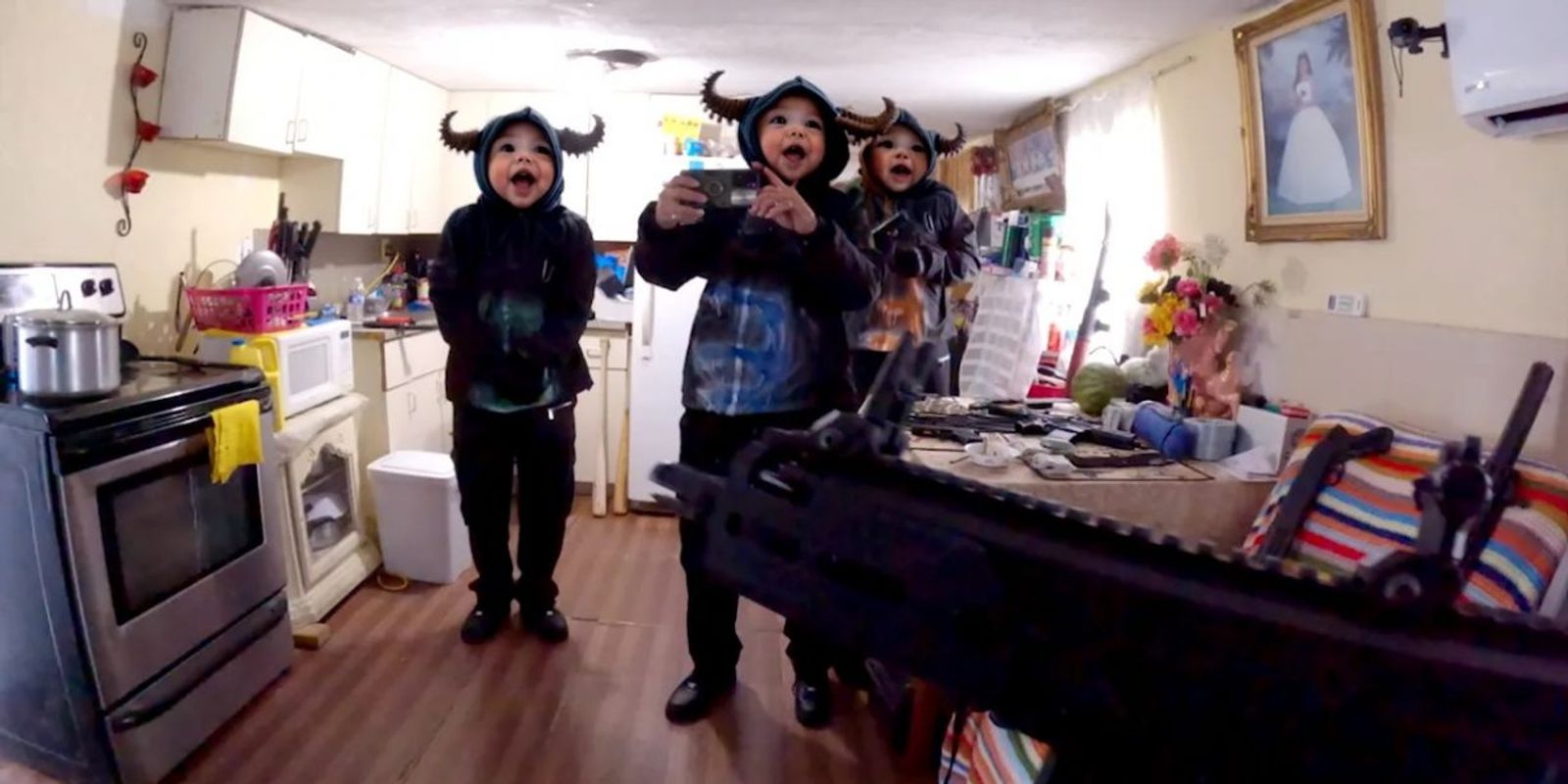
“Baby Invasion” by Harmony Korine. Courtesy of EDGLRD
We’re very concerned about the anatomy of slop, about isolating and dissecting it, giving name to its tendencies, its rapid and seemingly inevitable chaos. We engage in its mythology as though it’s a distant beast to conquer. Look at its terrible quality, its fruit cuckoldry, its smooth nothing. “It’s a sense of almost digital drugs,” is director Harmony Korine’s thesis. “Is there a way to have entertainment that’s kind of an emotional vibration?”
I think all the talk of play, experimentation, inebriation gets to the heart of a real cultural mire: that of our preoccupation with youth. That might look like the clear desire for eternal youth, as Bryan Johnson and looksmaxxing have shown us. But it also looks like unbridled, unregulated immaturity. A state built on callowness. An aesthetics based entirely on play and the shoddy fulfilment of juvenile desires – none more popular than the desire to return to soft-brained, embryonic times. Korine describes the surreal quality to AI films as “the idea of cinema that you can basically be inside.”
“An aesthetics based entirely on play and the shoddy fulfilment of juvenile desires – none more popular than the desire to return to soft-brained, embryonic times.”
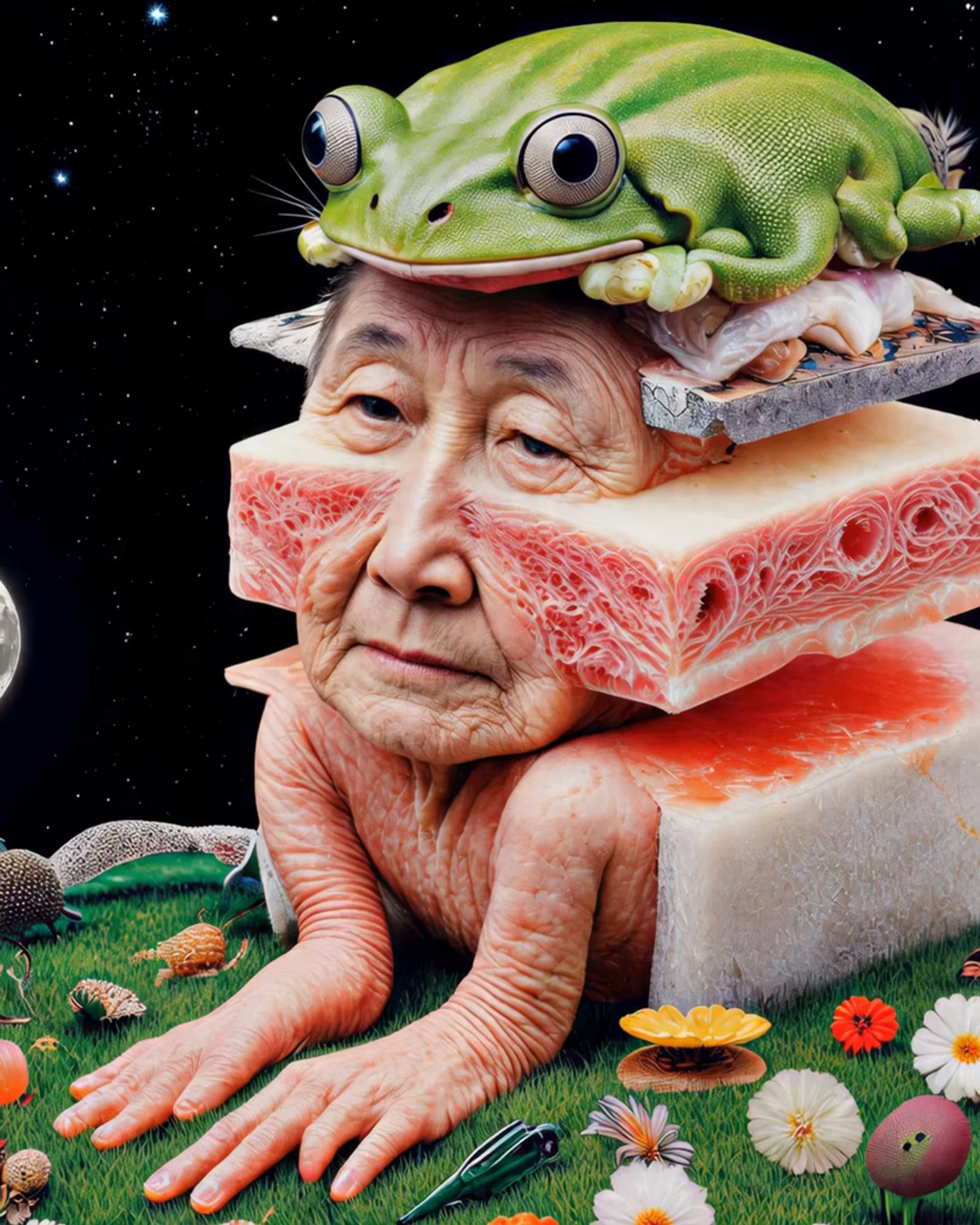
“frogauntie” by niceaunties. Courtesy of Load Gallery.
niceaunties’ Auntieverse satirises this phenomenon, purporting to situate the long-neglected Asian Auntie in total freedom, placing them in steaming hot noodle bathtubs, contorting them beyond recognition, if not for their aging faces. Her video ‘Aioli Times’ replaces the young, model minority overachiever in an Asian coming-of-age story with a fledgling garlic bulb. The bulb works to achieve their childhood dream of becoming a supermodel, spurred on by their supportive Auntie, only to trip on the runway at the edge of their burgeoning peak, ending their dream. Perhaps we need AI art to remind us that we’re out of the womb – that the horrors are real.
“Perhaps we need AI art to remind us that we’re out of the womb – that the horrors are real.”
Comments
Leave a comment