

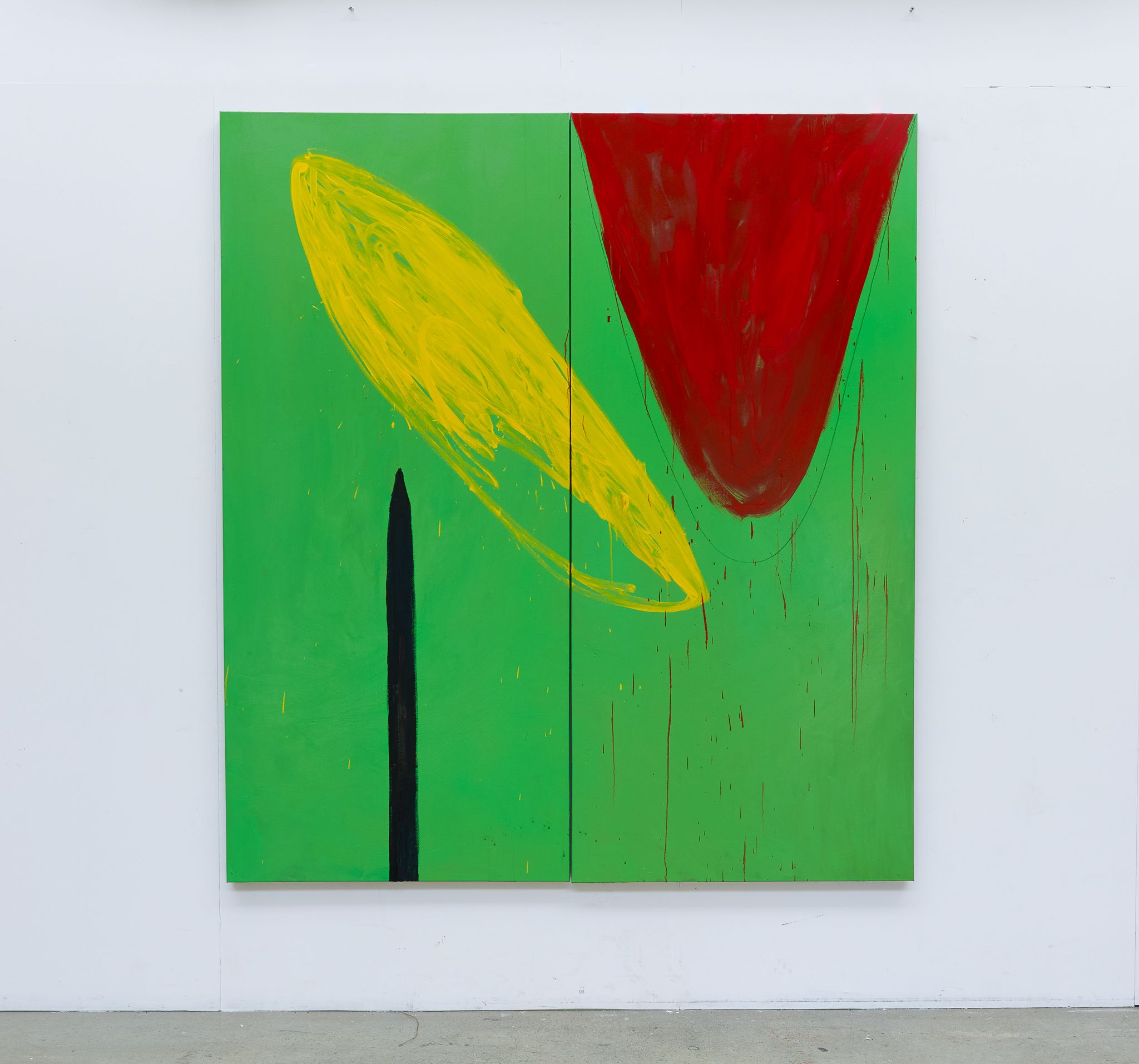
The Want of Cain (the Love of Abel), Oil, charcoal and canvas, 200 x 90 cm, 2026.
Striking fields of red, yellow, black and green meet in Anna Lauree’s The Want of Cain (the Love of Abel). Both immediate and bright, it demands attention, yet does not feel joyful. Something strange and unsettled appears in their combination. An uneasy tension lies within the composition, between want and love.
The insistent green was not originally intended to base this work, but appeared as an intermediate layer for another work. Lauree became so drawn to the colour she decided to follow it elsewhere. From there, each decision lead to another, with each colour field narrowing down the next decision until the composition arrived at its final iteration. An intuitive process which drove the diptych to somewhere Lauree describes as ‘a little more violent, a little more weird’.
Questioning the violence that can exist within want; ‘the intensity of needing something’ and the point which desire can become all-consuming. She did not set out to visualise a biblical story, and though the title draws on Cain and Abel, the painting did not begin there. Growing up with religious influences, Lauree drew the connection between the work and the story only after the painting already existed. Rather than illustrating the biblical story, the title offers another way for the viewer to enter it, one which places want and love at odds without prescribing a reading to the composition.
Lauree sees this painting’s ability to exist somewhere between the audiences desire to find a narrative in an image, and the act of simply allowing it to exist. The title offers a narrative to those who seek it, but the painting does not depend on it. What remains is a work which bares its contradictions proudly; bright and uneasy, intuitive and deliberate, wanting to be understood while resisting explanation.
Text by Bella Bullen.
Anna Lauree (b. 1995, Idaho, USA) is inspired by aspects of symbol and form, which are then seen through a lens of an industrialized society. Her compositions balance flatness, depth, and expressive marks through a questioning of relationship and gravity. Often reflective and referential to life experiences, her practice acts an ongoing search for internal truth. At the core of her practice is a continued acceptance of imperfection and humanity in our modern world.