

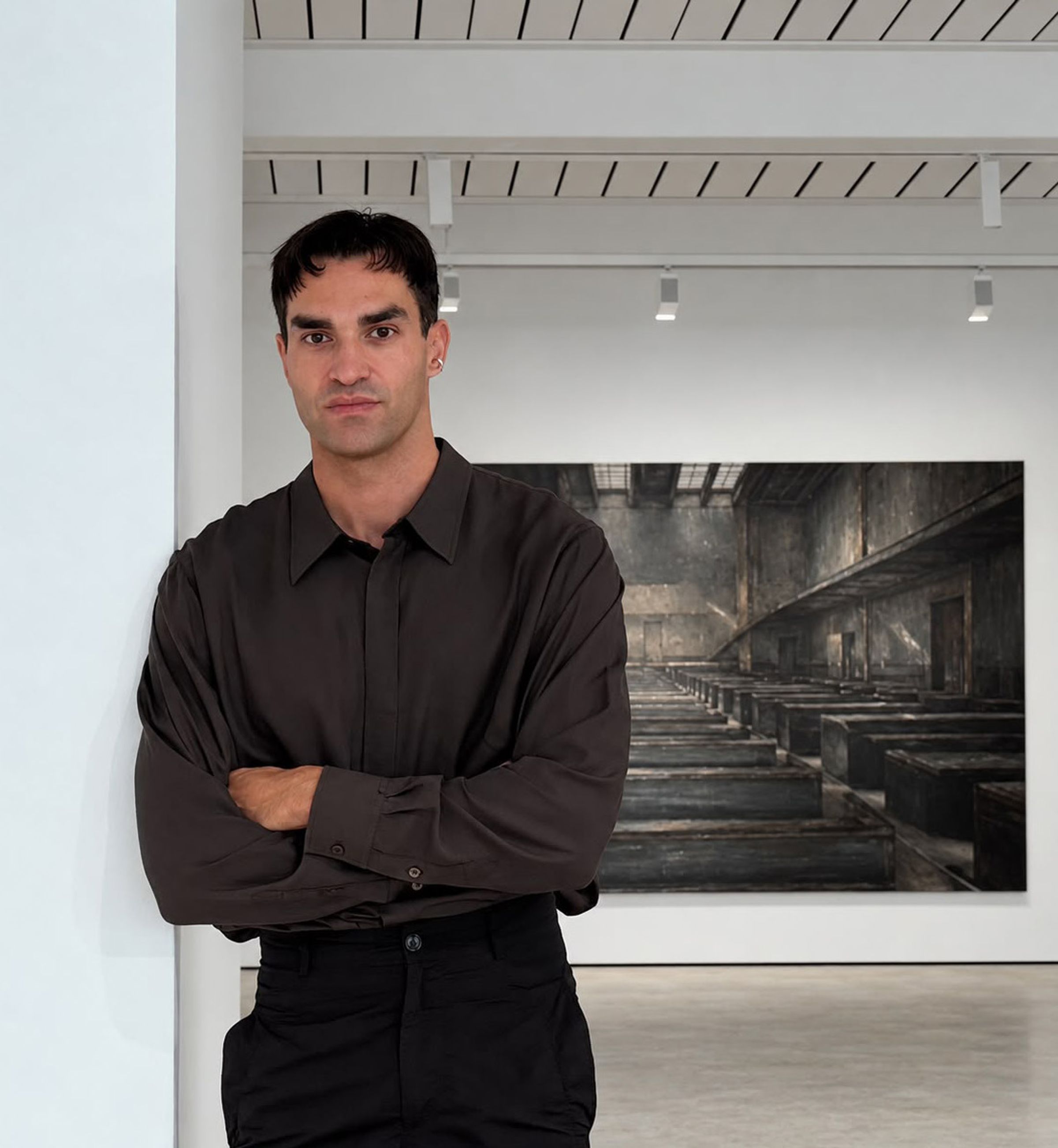
BB: You’ve moved between scientific research, philosophy and painting as ways of investigating the world. What does painting make possible as a form of thinking that those other forms might not?
EDC: I don't see them as rivals. Science tends to work towards results, and philosophy develops through argument. Painting, on the other hand, allows me to explore a question without necessarily having to resolve it. A painting can be precise and indeterminate at the same time.
I work with ideas around anarchism, archiving and plasticity, and the writings of the philosopher Catherine Malabou have been very important to me. But I'm not interested in simply illustrating these ideas. What does it mean to perform plasticity? What might an anarchic object look like, or an anarchic piece of architecture? I find that painting and sculpture allow me to approach these questions in ways that writing alone cannot. The materials themselves can change how I think about them.
I want to leave room for different possibilities, even contradictions, without necessarily having to reconcile them. In that sense, I see the works as both manifestations of thought and vessels for further thinking. At least, that's what I hope to achieve when putting together an exhibition.
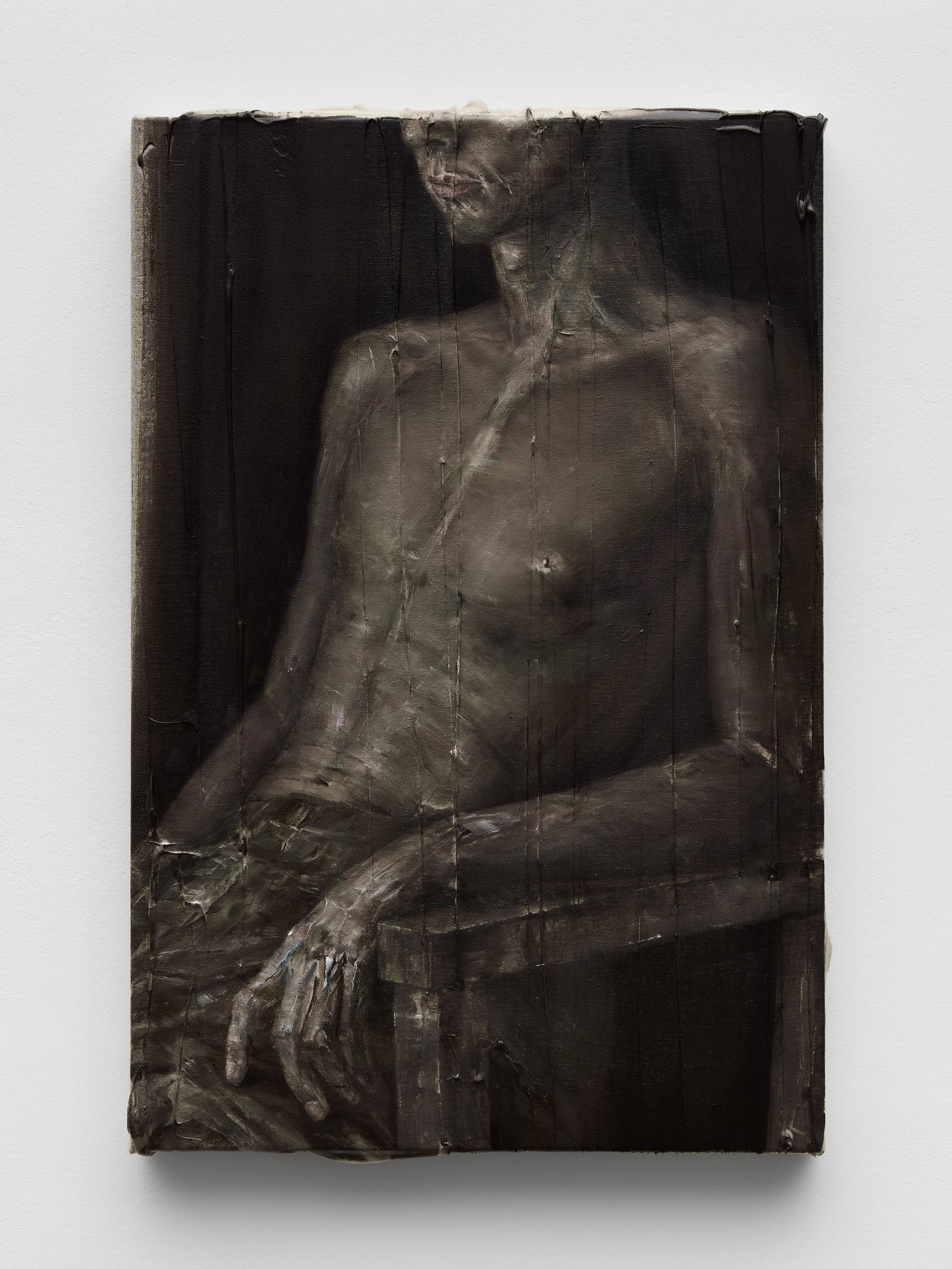
BB: Your paintings seem to reward sustained looking rather than immediate recognition. Has the way people encounter images today, with rapid consumption growing, affected how you think about making paintings?
EDC: Images get used up quickly now, but I'm not deliberately painting against that. I don't think the speed at which we consume images has changed how I paint, although perhaps it's made me more aware of what painting can do differently. What interests me is the moment when a first recognition turns out not to be enough.
In my paintings, recognition often comes quite quickly: a hall, an interior, a figure. But the longer you look, the less certain these things become. With sculpture, you might recognise the object immediately, but be less certain about what it's doing there.
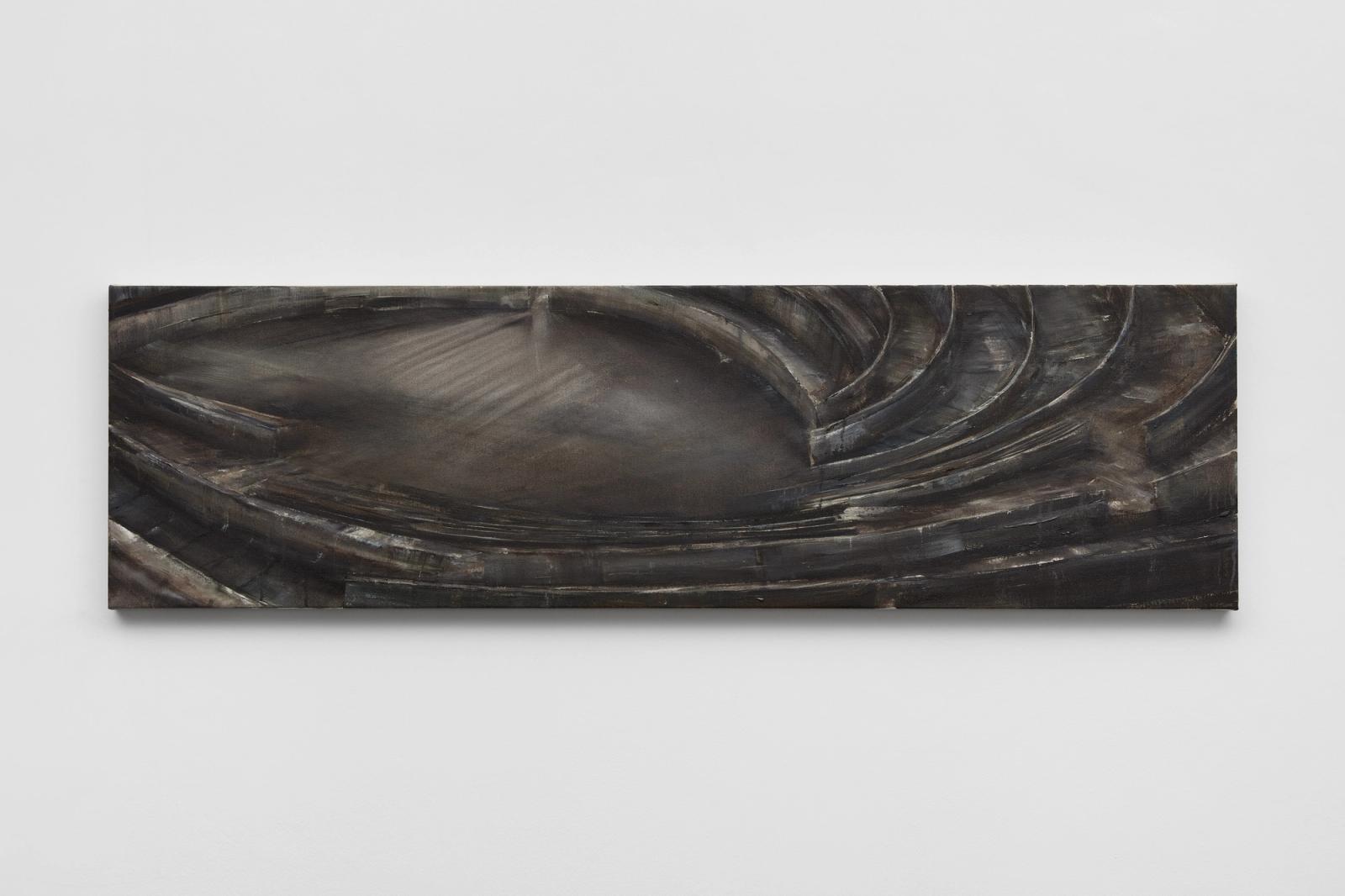
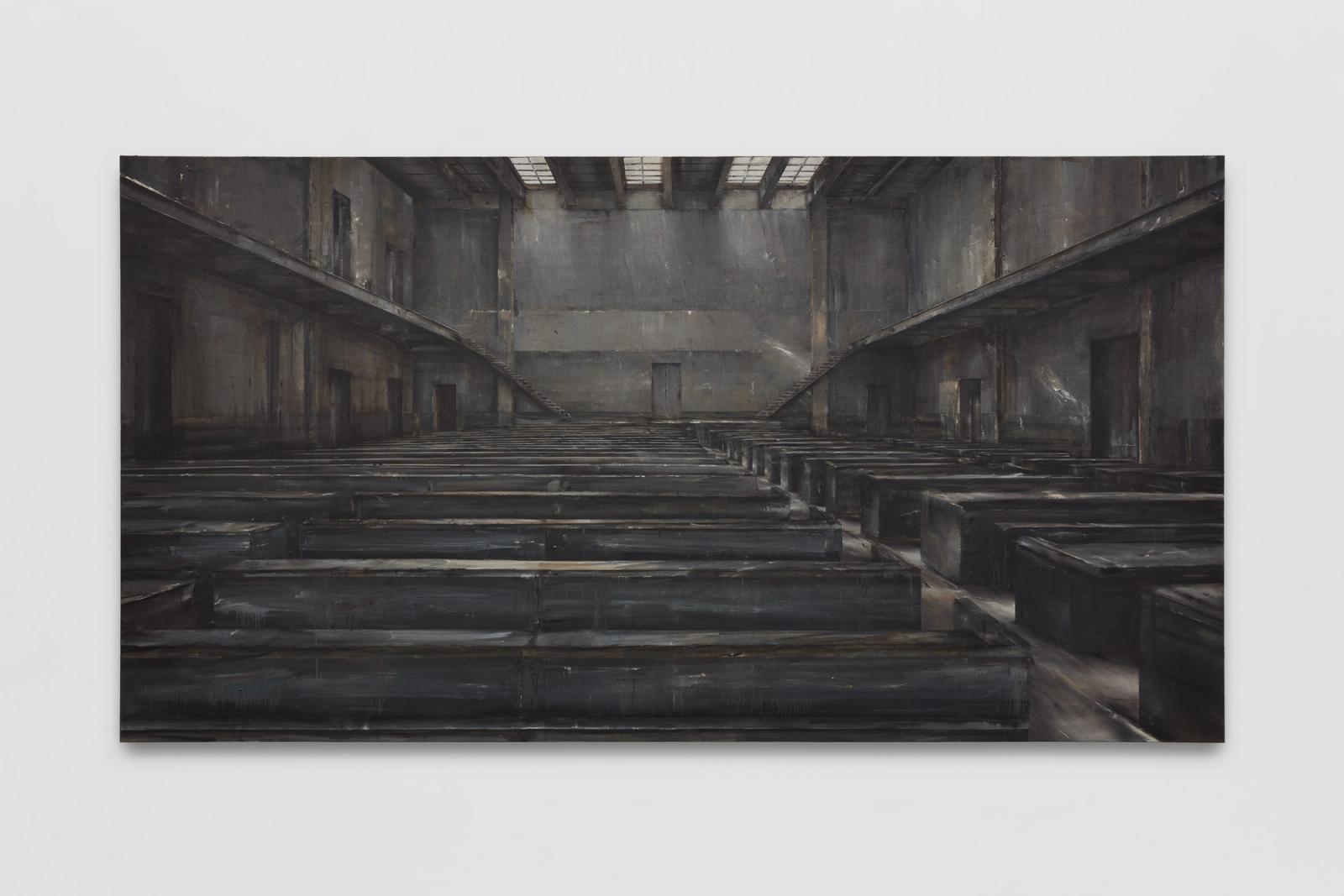
Untitled (calanque), which is currently on show at Gathering in London, is a good example. It's a small, wide painting that might initially resemble an auditorium, but the longer you look, the harder the architecture is to place. It breaks into repeated folds and curves that could suggest a building, a landscape or something anatomical.
I think paintings are slow objects. You can take in an image almost instantly, but that doesn't mean you've exhausted it. I suppose there's something of Derrida's différance in this. Meaning is always being deferred, and looking for longer doesn't necessarily bring you any closer to resolving it. The first reading is often the least interesting one. Looking for longer doesn't always make a painting clearer, and I'm happy with that.
BB: Through your practice you have collaborated with other thinkers. You’ve also described the studio as a fundamentally solitary space. How do those two ways of working inform one another?
EDC: Collaboration is quite central to my practice, although it can take different forms. Sometimes it's as indirect as reading someone's writing and responding to it, and sometimes it's much more direct, as happened with Catherine Malabou, with whom I collaborated on my exhibition of Malabou at Galerie Molitor in Berlin.
For that exhibition, I asked Catherine to produce a series of drawings. We met in Marseille, where I gave her pens, paper and postage materials, and a few weeks later the drawings arrived at my studio in London. I wanted to see what would happen if I had to respond to something I hadn't made or conceived myself. There was a certain constraint to that way of working, which I actually found quite liberating.
But most of the work still happens alone in the studio. I need that time to figure out how to respond to something that wasn't originally mine. Collaboration introduces something I can't entirely anticipate or control; the studio is where I can work through it on my own terms.
BB: One thing that struck me about your paintings is that they often sit at a point where something feels familiar, but never entirely settled. What interests you about that threshold?
EDC: I think it's central to the paintings. They often begin with something recognisable, a lecture hall, an auditorium, an institutional interior, and I work on the image until that recognition becomes unstable, without letting it disappear altogether. If something is entirely unfamiliar, there's very little to unsettle. I like that moment when you think you recognise a space, but the longer you look, the less certain you become.
Many of these paintings depict spaces designed to organise people. They determine where you sit, where you look, who speaks and who listens. But the people are absent, and what remains is the architecture, with its original function somehow suspended.
I've spent much of my life in these kinds of institutions, so there's something very familiar about them. But once you remove the people, you're left with the structures that organised them. I'm interested in how much of that authority remains when the space is empty.
BB: Your recent practice has become increasingly immersive through sculpture and installation. What has working at that scale opened up for you?
EDC: Sculpture allows me to approach many of the same questions from a different direction. Put simply, the paintings give absence to presence, and the sculptures give presence to absence.
In painting, I often start with something recognisable, a figure or an interior, and gradually make it less accessible. With sculpture, I can do almost the opposite. Something absent, a memory or a trace, can acquire a physical presence. At Galerie Molitor in Berlin, lack arkhe divided the basement into two spaces. You had to crouch beneath the sculpture to enter a narrow corridor, lit only by a thin opening above eye level. I wanted to give physical form to Catherine Malabou's idea of destructive plasticity, but also to create something that you couldn't experience simply by looking at it.
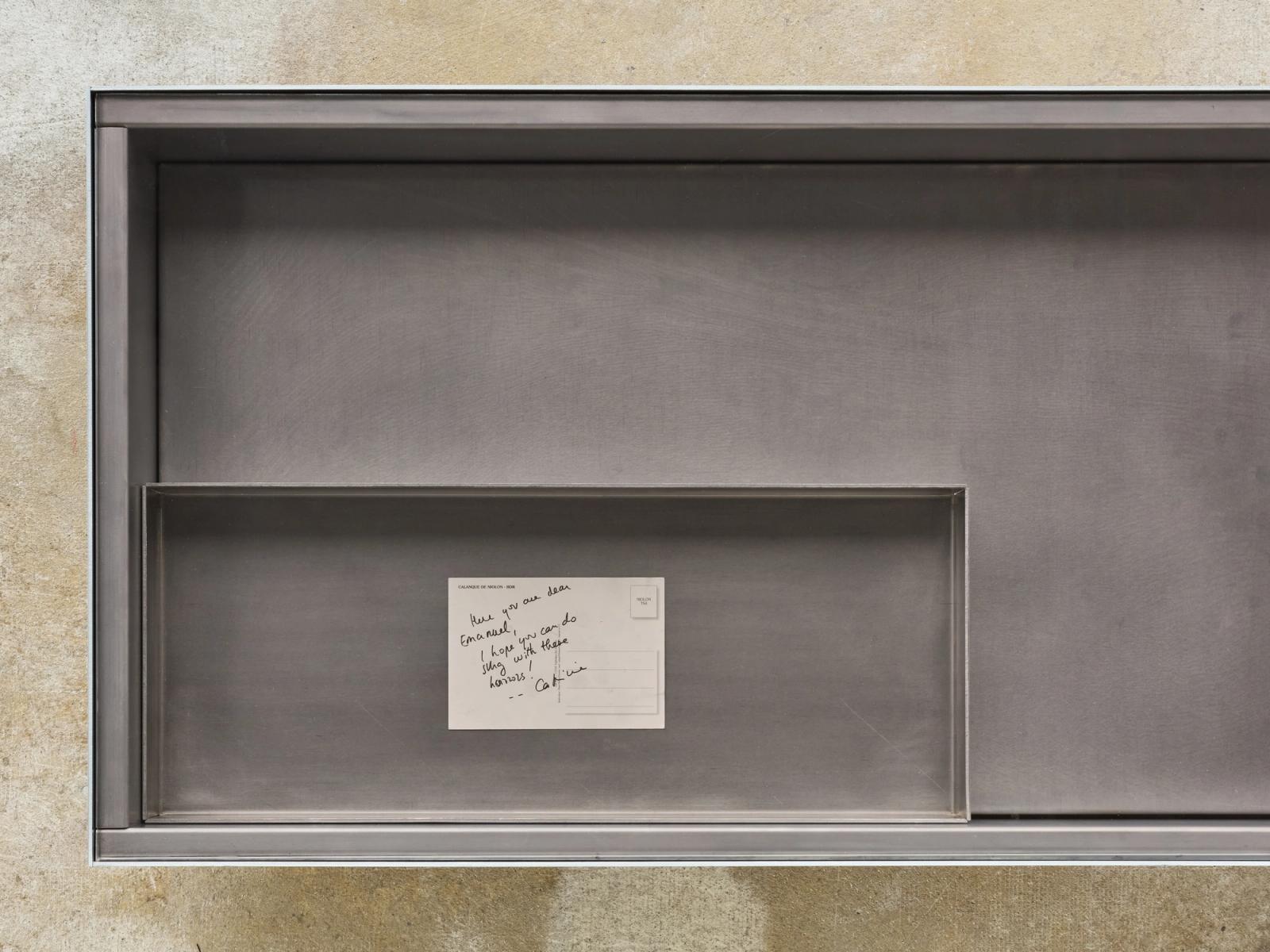
My current exhibition, postcard, fever, at Gathering in London, began with a postcard Catherine sent me from Marseille, with a handwritten note and an image of a calanque. I became interested in preserving this ordinary object, almost as if it were a future archaeological artefact. The postcard is now enclosed in an aluminium sculpture. Part of the postcard and the handwritten note remain visible, but the image of the calanque is concealed. So you can see the object, but not the image that prompted the exhibition in the first place.
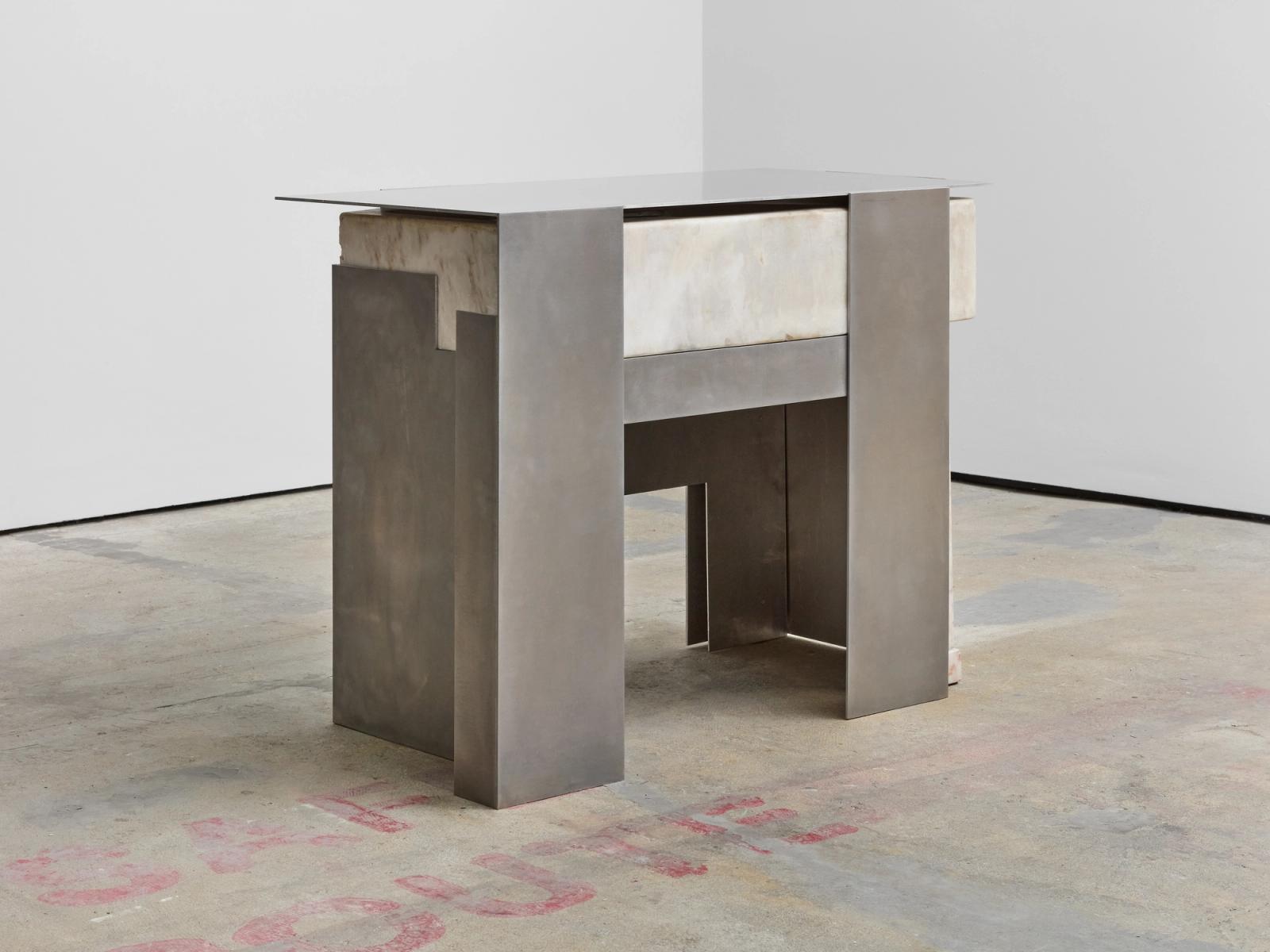
In the same exhibition, Untitled (basin) incorporates an old marble basin from Portugal, enclosed within an aluminium structure. I began thinking about it as an involuntary archive, in contrast to the postcard. The postcard was deliberately written and sent, whereas the basin was never intended to preserve anything. Yet its surface carries the marks of years of use, the stains, the wear, the damage. It becomes an archive without an archivist.
Working with sculpture has also changed how I approach exhibitions. I'm no longer thinking only about individual pieces, but about what happens between them. A sculpture can divide a room, conceal something or make a familiar space difficult to navigate. Even the distance between two objects becomes important. The architecture is no longer simply where the work is shown, it becomes part of the work itself.
Comments
Leave a comment