

BB: Your artist statement speaks about interconnectedness. Has that idea remained consistent for you, or has your understanding of it continued to evolve?
S: For me, interconnectedness has never been simply a theme within my paintings; it is the lens through which I observe reality. Long before I understood how to express it visually, I found myself continually noticing how every phenomenon seems to exist as part of a much larger network of relationships. Painting became the place where that ongoing observation could take material form.
What fascinates me is not simply that things are connected, but how they become connected. I'm interested in the invisible systems through which small events accumulate, interact and eventually produce realities far greater than the individual parts that created them. A single sentence can permanently alter someone's life. That person may then influence countless others, creating a chain of consequences that continues far beyond anything we could ever witness. The same principle appears in ecosystems, where the disappearance of one species can transform an entire environment, or in network science, where seemingly insignificant nodes can dramatically reshape the behaviour of the whole system. Again and again, different disciplines seem to arrive at a similar observation: relationships are often more fundamental than the individual elements themselves.
I've always been fascinated by this recurring pattern. Whether I look at biology, ecology, systems theory, mathematics or human behaviour, I encounter different languages describing remarkably similar phenomena. Rather than seeing these fields as separate, I find it more interesting to ask why they so often converge around the same questions: How does complexity emerge? How do local interactions generate global structures? How does a small gesture become something much larger than itself?
This way of thinking has gradually become less of an intellectual interest and more of a daily practice of observation. Once I began noticing these patterns, I realised they appeared everywhere. Every conversation, every encounter, every decision, every physical process seems to exist within an endless web of reciprocal influence. The world no longer appears as a collection of isolated objects, but as an evolving network in which everything is continuously affecting and being affected by everything else.
Because of that, I don't think my understanding has fundamentally changed. If anything, it has become increasingly layered. I no longer see interconnectedness as an idea that needs to be defended or illustrated. It has become the question through which I understand almost everything I encounter. My paintings are not intended to explain that idea. They are attempts to observe it—to make visible, however briefly, some of the hidden structures through which reality continuously forms itself.
BB: Has studying and working in London introduced conversations or influences that have surprised you?
S: Absolutely. Looking back, I think London changed me in a much deeper way than I realised while I was living there. When I eventually returned to Greece, it became clear that I wasn't the same person who had left. My way of understanding people, society and even my own practice had permanently shifted.
One of the greatest gifts London gave me was perspective. Growing up in a relatively small country, it's easy to unconsciously assume that your own cultural experience is the default. Suddenly I found myself surrounded by people from every corner of the world, each carrying completely different histories, beliefs and ways of seeing. At the Royal College of Art especially, every conversation became an opportunity to understand a reality I had never personally experienced. It taught me that there is no single way of interpreting the world; there are countless realities existing simultaneously.
That experience reinforced something I had already been thinking about for years: that everything exists through relationships. Ideas don't develop in isolation. Neither do people. We continuously shape one another simply by existing together.
Another thing that deeply affected me was the place that art occupies within London's culture. For the first time, I lived somewhere where visiting exhibitions was part of everyday life. People move from gallery to gallery with genuine curiosity, not because they work in the art world, but because art is woven into the city's cultural rhythm. Coming from Greece, where pursuing art is often considered unrealistic or secondary, this was incredibly moving. It made me feel that what I had chosen to dedicate my life to was not something peripheral, but something capable of contributing meaningfully to society.
London also taught me that diversity is far more than coexistence; it is a continuous exchange. Walking through the city feels like moving through an ecosystem of cultures, languages, histories and traditions, each influencing the others while still retaining its own identity. I often think about London as a living network rather than simply a city. That experience didn't change the questions I was asking as an artist, but it expanded the scale on which I began asking them.
BB: Your paintings begin with digitally altered photographs, yet the final work is made through one of painting's most traditional mediums. What interests you about moving between those different ways of making images?
S: It actually took me many years to realise that this process belonged to my painting practice at all.
For a long time I was searching for a visual language that genuinely felt like my own. I kept asking myself a simple question: What do I do naturally that nobody taught me to do? I wanted to discover something that had already been part of me for years without fully recognising it. Then one day I noticed something I had been doing almost my entire life.
Ever since I was very young, one of my favourite things to do was to photograph ordinary moments and then spend hours digitally manipulating those images. I wasn't trying to make them more beautiful or more realistic. I was trying to see what else was hidden inside them. I would repeatedly apply filters, layer after layer, until the image began to collapse. Colours shifted into unexpected palettes, details dissolved into textures, and the photograph slowly transformed into something that no longer represented the visible world but revealed another possible version of it.
What fascinated me most was that these weren't simply filters placed on top of an image. They fundamentally reorganised the image itself—almost as though they were rewriting its internal structure. As the digital information gradually degraded, another phenomenon emerged that completely captivated me. The collapsing pixels began to resemble painterly marks. Through the destruction of a digital image, an entirely new visual language appeared—one that reminded me of Impressionism and Pointillism, except that these marks had been generated electronically rather than by a brush.
Eventually I realised that what I had thought was simply a private fascination was, in fact, an unconventional way of painting. I wasn't editing photographs; I was investigating images. I was asking how many realities could exist within a single photograph if I kept transforming it.
Today those altered images become the beginning rather than the destination. They provide a map of possibilities, but the painting never attempts to reproduce them. Instead, I translate them into oil paint, allowing another material—with its own physical behaviour, capability and intelligence—to enter the conversation.
In that sense, my practice is less about moving between digital and traditional media than it is about translation. I'm interested in what happens when one visual language is interpreted through another, and in the discoveries that become possible precisely because no translation is ever perfect. The spaces between those two worlds are where the painting begins to develop a life of its own.
BB: You describe your paintings as being "controlled down to the smallest touch," even though they often appear fluid and organic. How do you think about that relationship while you're working?
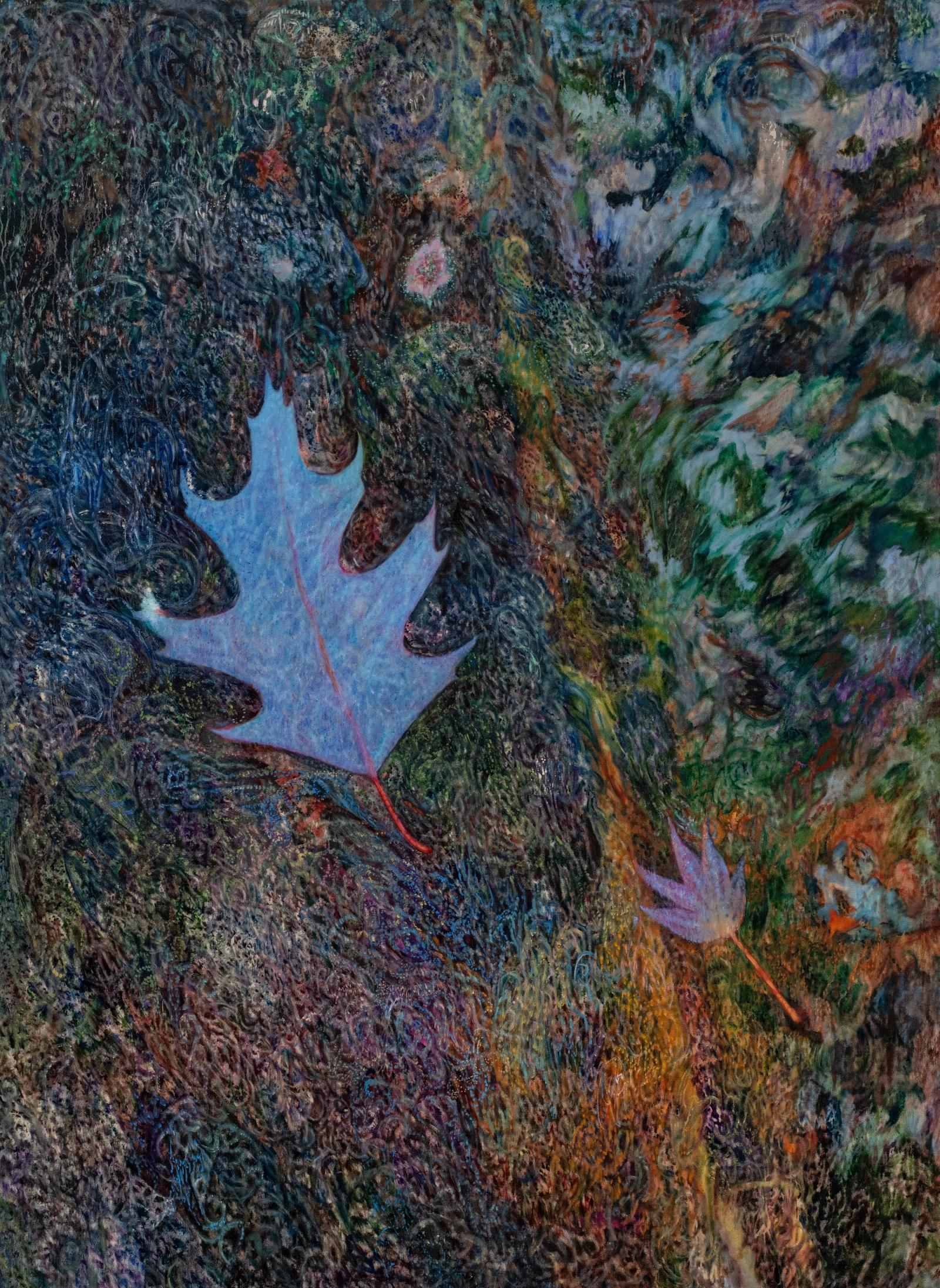
S: I've always been fascinated by the fact that nature often appears spontaneous, even though it is governed by extraordinarily precise processes. The patterns left by rain on a window, the texture of tree bark, the way freckles gradually emerge on skin, the branching of rivers, the growth of fungi, the accumulation of dust, even the distribution of stones after they are scattered across the ground— these phenomena often look random, yet they arise through physical laws, interactions and conditions that are remarkably specific.
I'm interested in that tension between apparent randomness and underlying order.
Different scientific fields describe this in different ways. Complexity science, systems theory and pattern formation all show that highly organised structures can emerge from countless local interactions without the need for a central designer. What fascinates me is not certainty or predictability, but the idea that complexity itself has structure—that what appears chaotic may simply be operating according to principles we cannot fully perceive.
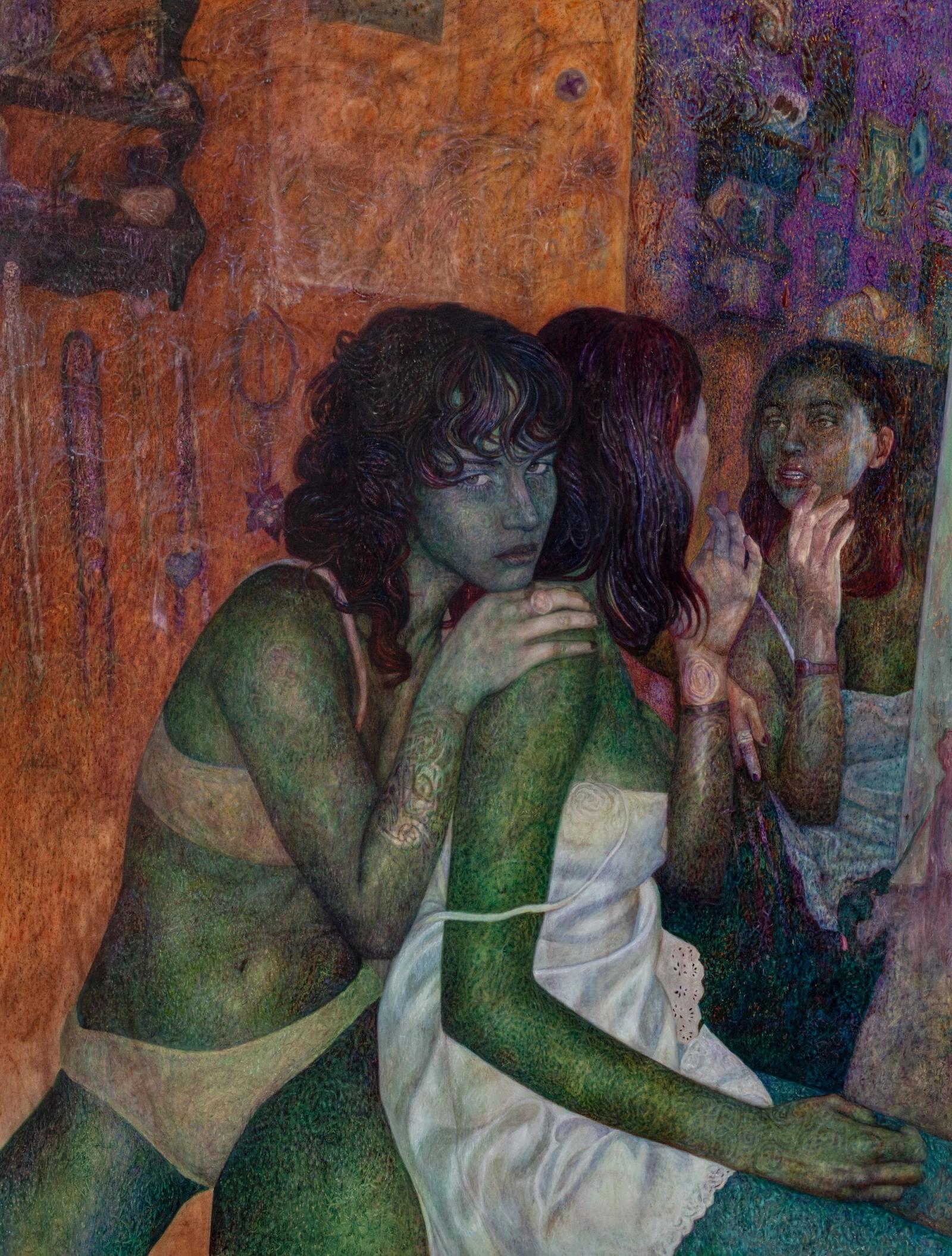
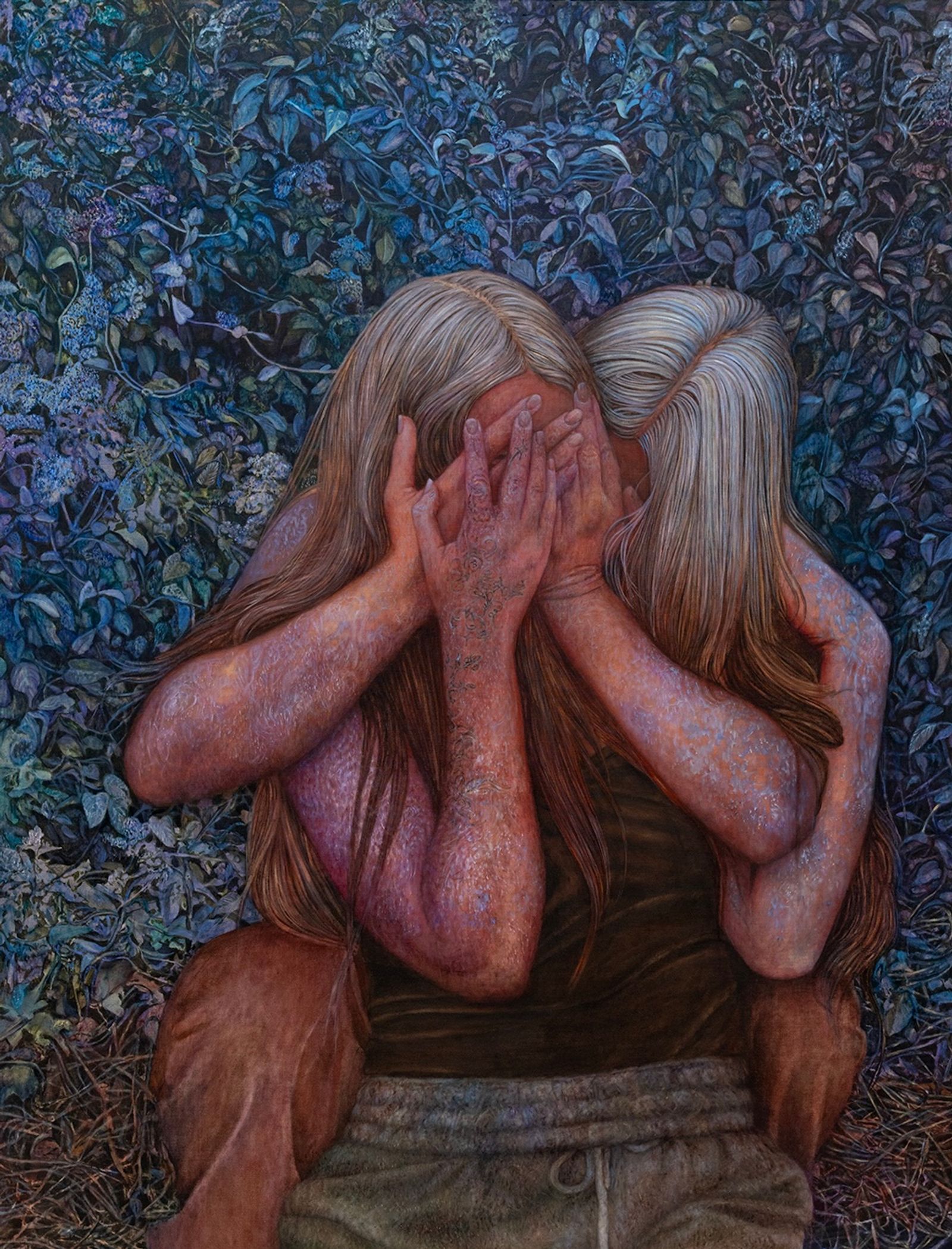
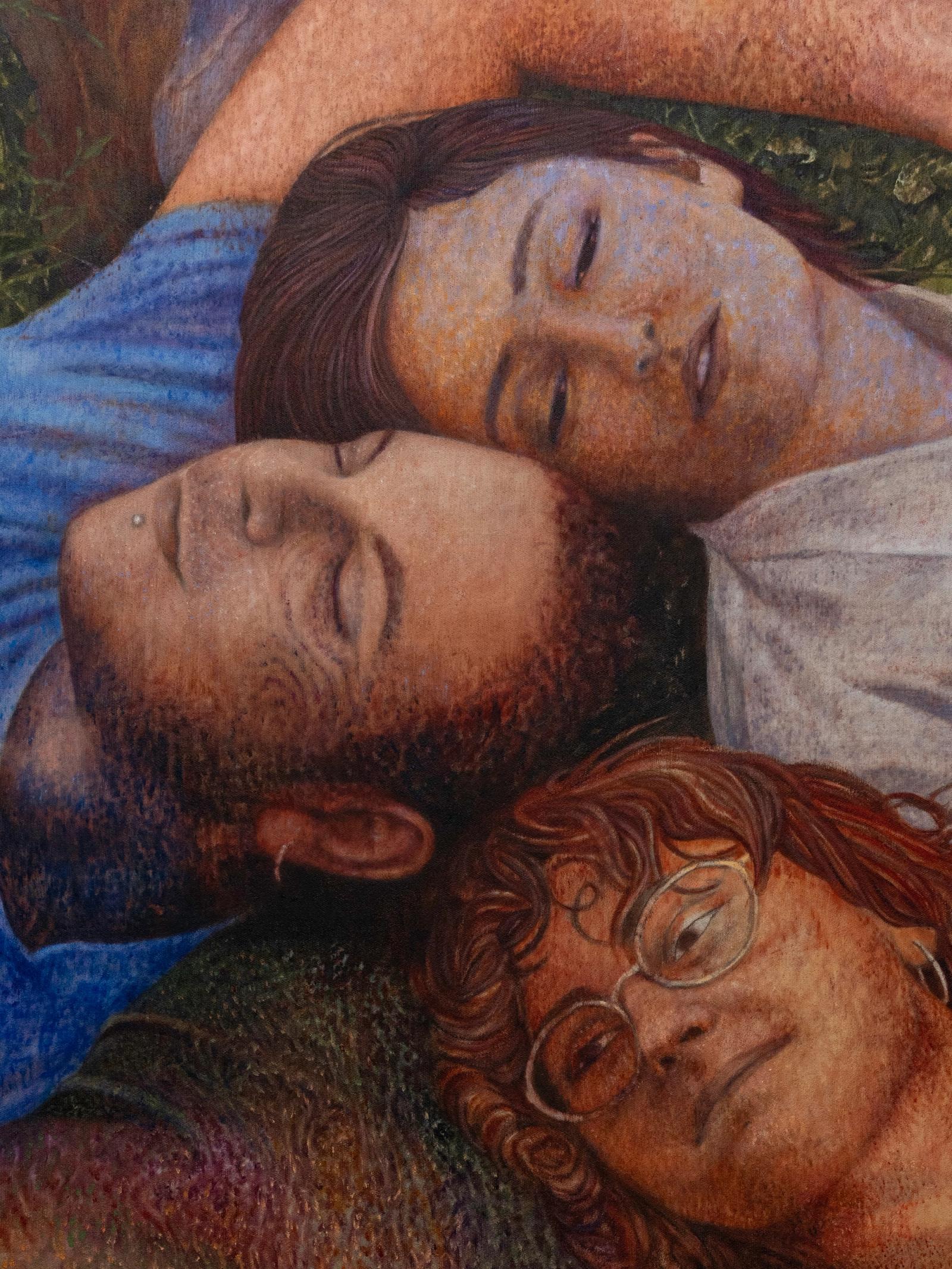
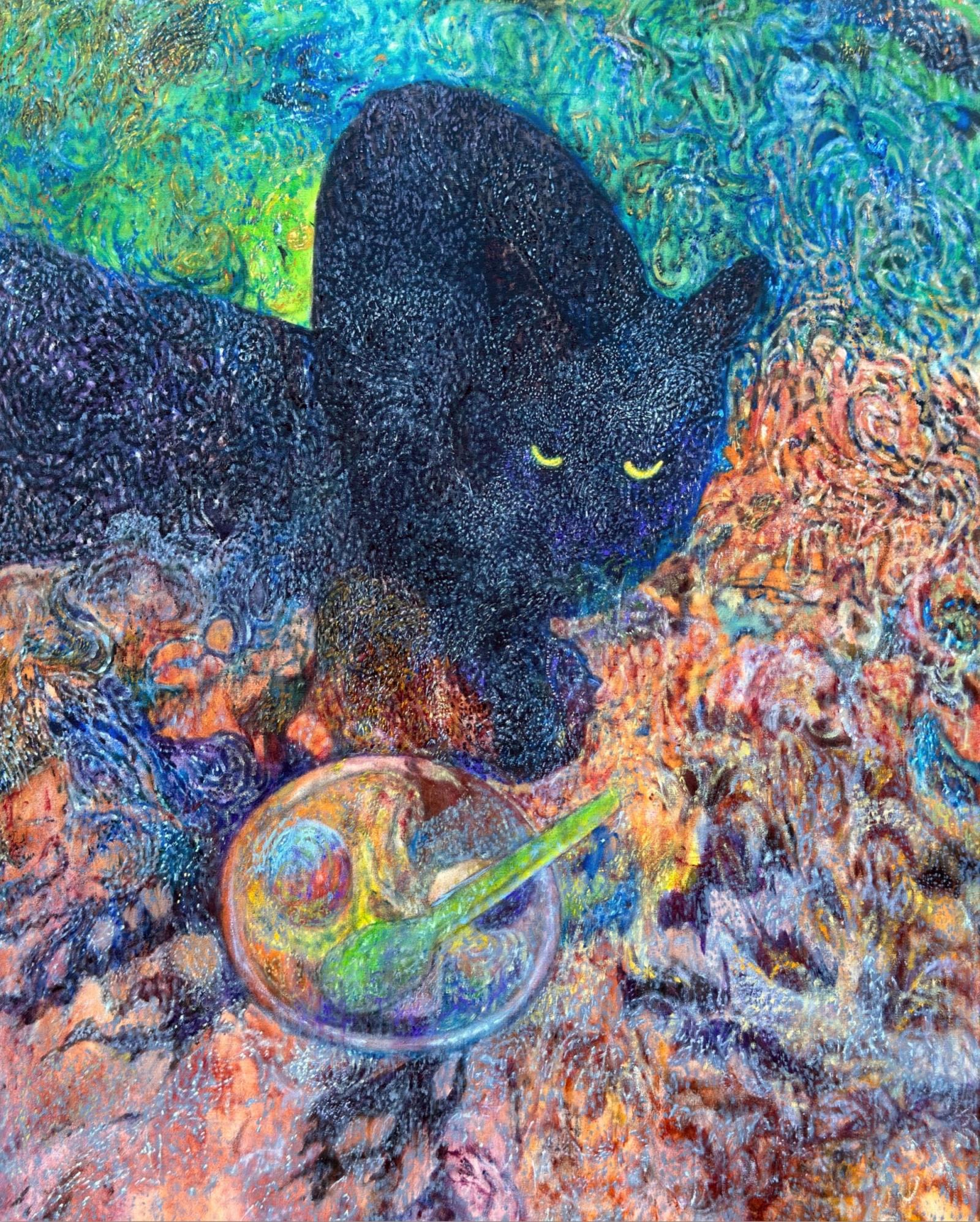
That observation profoundly influences the way I paint. My surfaces often appear fluid, organic or even accidental, but every mark is placed deliberately. My pointillist language is built through thousands of individual decisions that continuously respond to one another. Rather than composing a painting from large gestures, I allow it to emerge from the accumulation of very small ones, much like natural systems themselves develop through repeated interactions over time.
In many ways, I'm not trying to imitate the appearance of nature. I'm trying to understand how nature produces appearance in the first place. How does rain draw on glass? How does erosion paint stone? How does time leave traces on skin? How do living systems generate endlessly complex surfaces without ever repeating themselves? Painting becomes my way of studying those questions. Every brushstroke is both a decision and an observation, an attempt to participate in the same processes that continuously shape the visible world.
BB: Do you ever find yourself surprised by one of your own paintings once it's finished?
S: Very often—and I hope that never stops happening. Although my paintings are carefully planned, I never want them to become acts of execution. If I already knew exactly what the final image would look like before I began, there would be very little reason to paint it. I could simply reproduce an image like a printer. What interests me is discovering something that neither I nor the original image could fully anticipate.
The digital image, the preparatory studies and my initial intentions provide a structure, but they don't determine the outcome. Oil paint has its own material intelligence. Colour behaves differently once it exists physically. Optical relationships emerge that couldn't have been predicted on a screen. Sometimes a passage that seemed insignificant suddenly transforms the entire painting. A single brushstroke can unexpectedly reorganise every relationship around it.
Those moments still surprise me.
There have been paintings that I expected to become relatively quiet works, only for them to reveal an entirely different presence as they developed. Others have slowly drifted away from my original plan, and instead of resisting them, I've learned to follow where they seem to want to go. That dialogue is one of the most rewarding parts of the process.
People often assume that control and discovery are opposites, but I experience them as complementary. Careful structure creates the conditions in which genuine surprise can happen.
Sometimes, after months of working on a painting, I step back and genuinely ask myself, How did this happened? How did I do that, Not because I wasn't the one making every decision, but because the accumulated effect of thousands of deliberate marks can eventually produce something that feels greater than the sum of its parts.
Perhaps that's what continues to fascinate me most about painting. It constantly reminds me that complexity cannot always be understood by looking at individual elements alone. At a certain point, something new emerges—something that wasn't present in any single brushstroke, but only became visible through their relationships.
And maybe that's where these five questions quietly come together. Whether I'm thinking about people, ecosystems, digital images or paint itself, I'm always returning to the same mystery: how countless small interactions gradually become something that none of them could have produced alone.

Comments
Leave a comment